







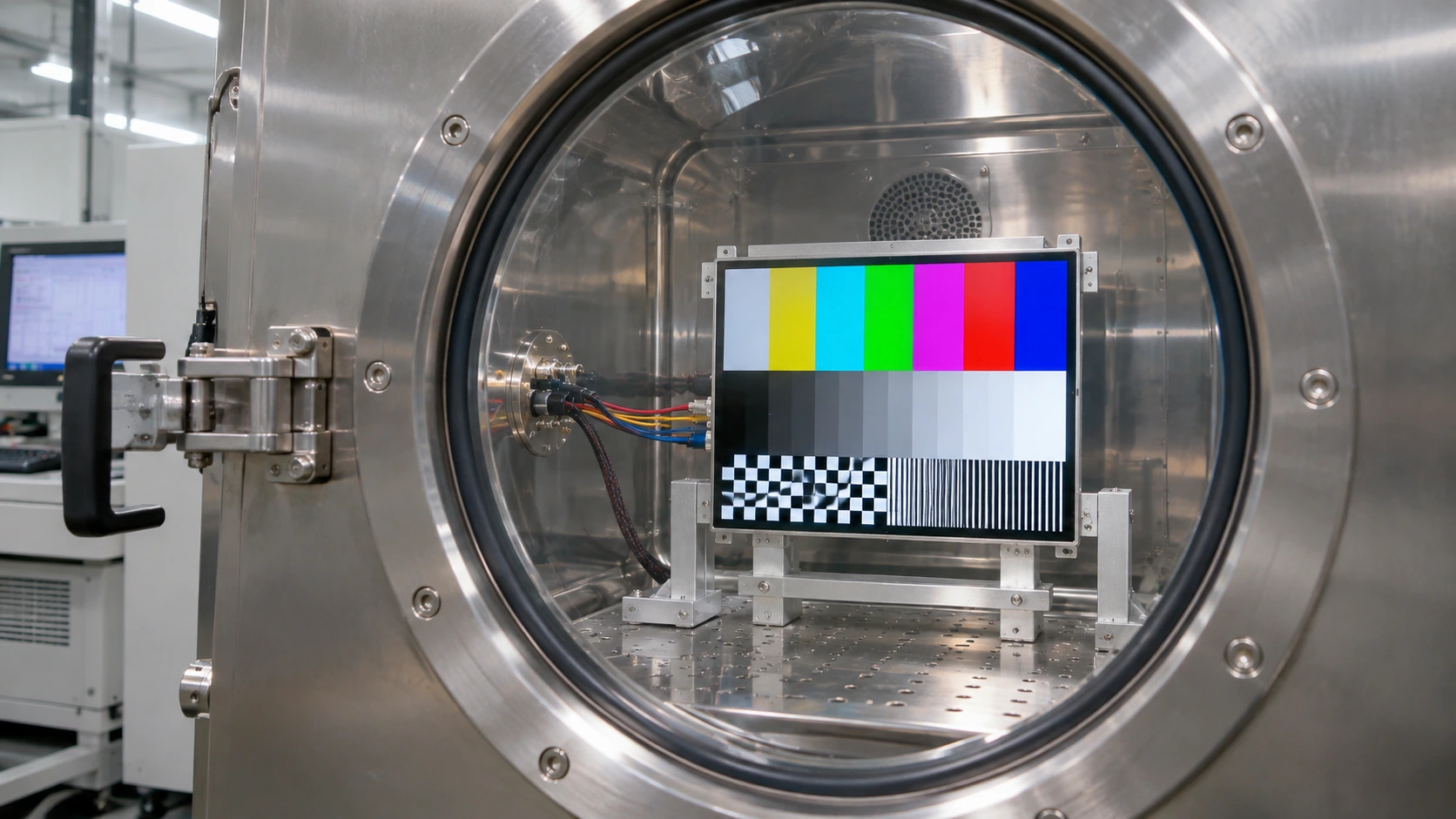
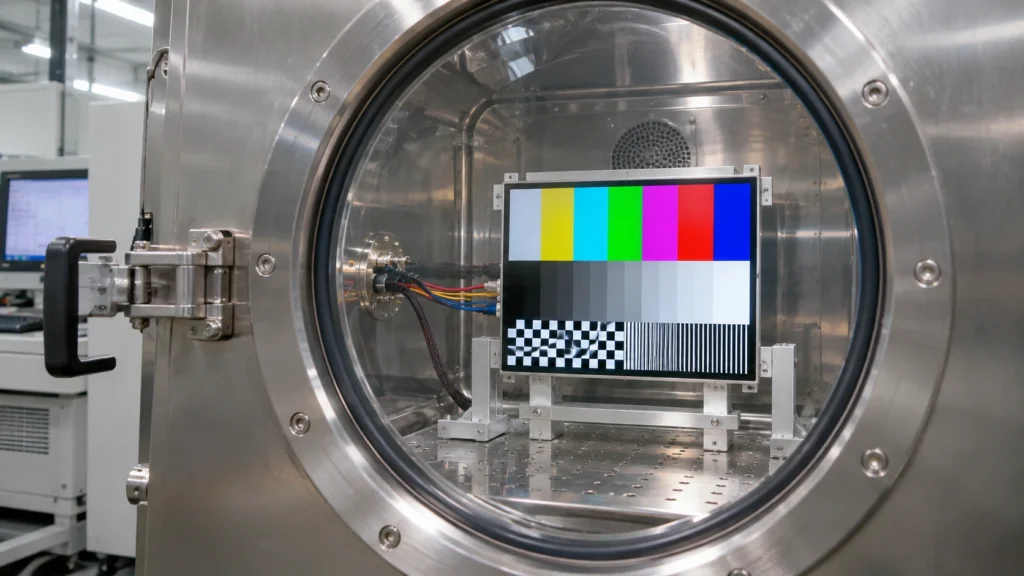
Before buying a TFT LCD module for a high-altitude installation, request a traceable low-pressure test report for the exact configuration being quoted. It should identify the samples, pressure profile, temperature, exposure duration, powered state, measurements, and acceptance limits. A statement such as “tested for altitude” leaves too much unresolved.
The purchasing decision is whether the evidence covers your operating and transport conditions. A module that works after an unpowered exposure has answered a different question from one observed continuously while running at reduced pressure.
Define the Altitude Requirement Before Requesting Evidence
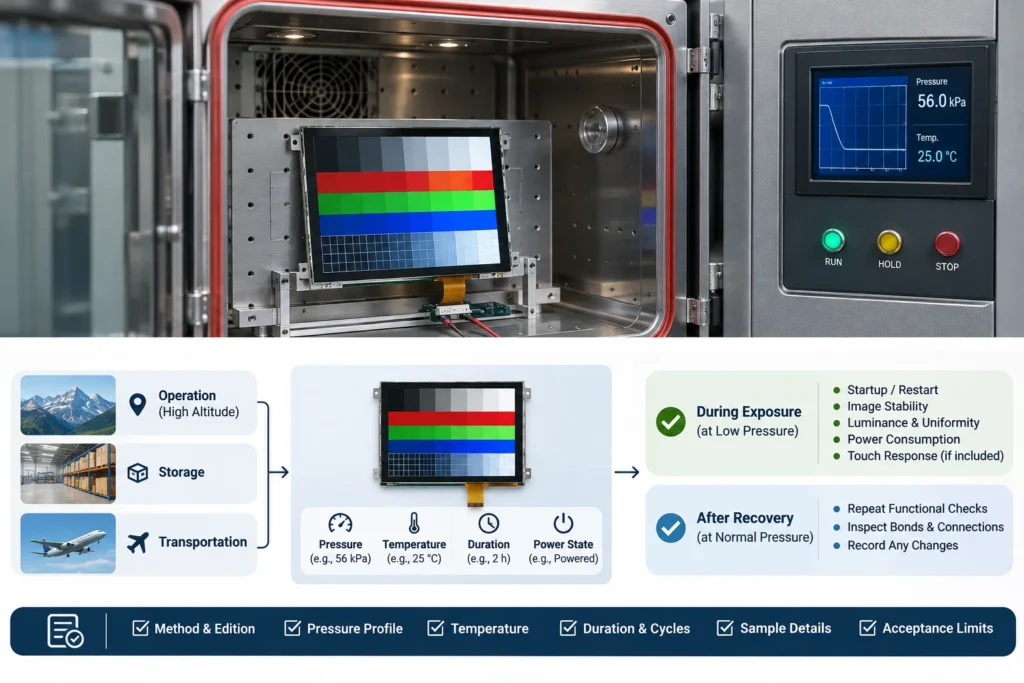
Start with the environment the module will actually experience. Separate normal operation, storage, and transportation. Record the highest installation altitude, expected exposure time, ambient-temperature range, and whether the module must start or restart under those conditions.
Specify chamber pressure as an absolute value, with units, alongside any equivalent altitude. Ask which atmosphere model supports the conversion. An altitude label alone is a poor basis for comparing reports with different pressure settings.
Also describe the installation: open ventilation, restricted airflow, or a sealed enclosure. Chamber air pressure and the pressure experienced inside a sealed assembly may differ. Engineering should decide how the test fixture represents that boundary.
Turn these inputs into a requirement sheet before requesting quotations. Otherwise, suppliers may offer different tests that appear comparable only because each report uses the word “altitude.”
Match the Report to the Module You Will Purchase
Ask for the complete report, including appendices and deviations, rather than a certificate cover page. Match its part number, suffix, drawing revision, and sample identifiers to the quotation.
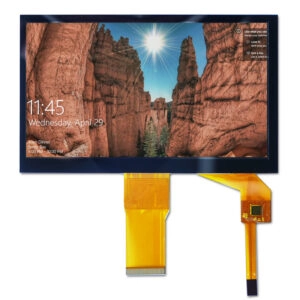
Record the LCD panel, backlight configuration, cable, connector, touch overlay, cover glass, and bonding arrangement where applicable. A report for a bare module does not automatically establish the behavior of a modified assembly.
Use the TFT LCD module datasheet review guide to connect report identity with controlled mechanical and electrical specifications.
If the tested product belongs to the same family but differs from the proposed module, request a written applicability assessment. It should explain the differences, their relevance, and any additional validation needed. Shared diagonal size or resolution is insufficient justification.
Check What the Altitude Test Actually Covered
The report should make the exposure reproducible. A method name without the selected conditions cannot show whether the test matches the project.
| Evidence to request | Buyer’s review question |
| Method, edition, procedure, and deviations | Was the agreed method followed, and what changed? |
| Absolute pressure and recorded profile | Did the samples reach and hold the required condition? |
| Pressure reduction and recovery rates | Do transitions represent the specified exposure? |
| Temperature and stabilization record | Were the required environmental conditions established? |
| Duration and number of cycles | Does the exposure cover the agreed test plan? |
| Power state and electrical settings | Was the module running, starting, or unpowered? |
| Fixture and assembly photographs | Does mounting represent the intended configuration? |
| Sample count and individual results | Did every tested unit meet the acceptance criteria? |
Request recorded conditions, not only chamber setpoints. Include relevant instrument identification and calibration status so the project team can assess measurement traceability.
Where the purchasing specification names a standard, confirm the edition and selected procedure with the responsible engineer. Do not treat a standard number as a universal altitude rating or evidence that every possible operating condition was evaluated.
Require Results During Exposure and After Recovery
For operational qualification, ask what was measured while pressure remained low. A final photograph taken after normal pressure returned cannot establish continuous operation during exposure.
Agree on relevant checks before testing: startup, image stability, luminance, uniformity, grayscale visibility, power consumption, and touch response when included. Record drive settings, displayed patterns, measurement positions, and observation intervals. The controlled LCD sample comparison guide provides a useful basis for keeping optical comparisons consistent.
Ask whether any resets, interruptions, adjustments, or unusual observations occurred. A report should preserve those events even when the sample eventually meets its final limits.
After pressure recovery, repeat the agreed functional and visual checks following a defined recovery period. Inspect relevant bonded interfaces, mounting points, and connections. Distinguish temporary changes observed during exposure from persistent changes afterward; the acceptance plan should explain how each affects approval.
Set Acceptance Limits Before Testing Begins
“Display normal” is difficult to enforce without a definition. State which functions must remain available, which visual changes are acceptable, and which measured values must stay within agreed limits.
For optical measurements, distinguish an absolute minimum from an allowable change relative to baseline. Keep viewing geometry, image content, instrument position, and backlight setting consistent. Otherwise, a reported difference may reflect the setup.
Avoid inventing a generic sample quantity or percentage tolerance. Engineering and quality teams should select these from project risk, specification limits, and expected production variation.
Review individual results. An average can conceal a sample that failed a critical requirement. Any retest should include its reason, configuration changes, and approval disposition.
Compare Supplier Evidence Before Releasing the Order
Place each supplier’s evidence against the same requirement sheet. Classify every item as demonstrated, partially covered, or unverified. Identify whether a gap requires clarification, an applicability assessment, or additional testing.
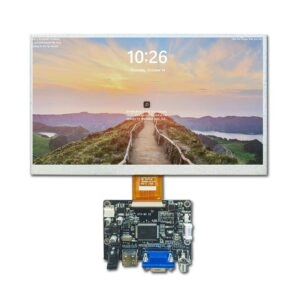
Miqidisplay offers a 10.4-inch industrial TFT LCD module with published interface, dimensional, and temperature information. Those specifications help establish a candidate configuration; they do not establish altitude qualification. Request applicable low-pressure evidence separately.
If the project requires cable, cover-glass, or touch changes, review the proposed module customization options and freeze the resulting configuration before qualification. Confirm which changes would trigger a new technical review.
Tie the accepted report to the purchase specification and approved revision. Clarify whether testing is design qualification or a recurring batch requirement. Record who approves deviations and what evidence must accompany future configuration changes. This prevents an initially useful report from becoming detached from the modules delivered later.
Conclusion
Useful altitude test evidence connects the intended environment, the purchased module, the exposure profile, and measurable acceptance criteria. Procurement should release approval only when those connections are documented or outstanding gaps have an agreed disposition. A clear report scope matters more than an impressive altitude claim.
FAQs
Does a storage altitude test prove operation at altitude?
No. An unpowered test can support storage or transport requirements within its stated scope. Powered operation and startup require evidence covering those states.
Can a wide operating-temperature range replace altitude testing?
No. Temperature and pressure describe different environmental conditions. Confirm whether the evidence covers the combination required by the application.
Is testing one module enough to approve production?
That depends on project risk and the qualification plan. One result describes the tested sample; it does not by itself establish variation across production.
Must a customized module be retested?
Review the change first. Differences in construction, mounting, bonding, or electrical loading may require additional evidence. Document the engineering decision rather than assuming earlier results transfer.
Request an Altitude-Focused Module Review
Request a Miqidisplay technical fit review with your required altitude or absolute pressure, operating and transport profiles, and available test specification. Include display type, diagonal size, outline dimensions, active area, resolution, interface, touch requirement, brightness, viewing direction, operating temperature, mechanical constraints, quantity, drawings, and integration environment.
These inputs provide the basis for assessing component fit, proposed customization, sample configuration, and documentation gaps. Ask Miqidisplay to confirm which altitude evidence applies to the quoted module and what remains to be validated before quotation assessment and sample approval.
Email: mary@miqidisplay.com
WhatsApp: +86 189 6801 5464