





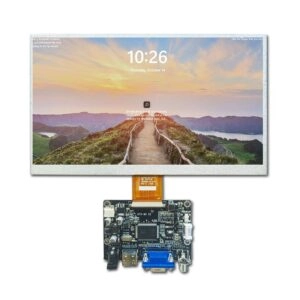
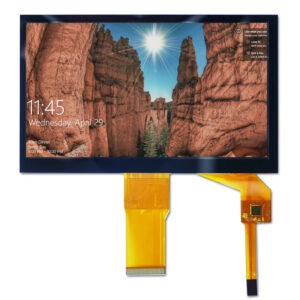


An industrial TFT LCD module can pass a short visual inspection and still reveal problems after extended operation. Brightness may decline, startup behavior may become inconsistent, the backlight may show unevenness, or the module may react differently after heat exposure and repeated power cycles.
This is why sample aging in industrial LCD validation should be treated as a separate approval gate rather than being hidden inside a general sample inspection. A sample approval check confirms whether a module appears to meet the specification at a defined moment. An aging test examines whether that performance remains stable after controlled operating stress.
For OEM engineers, quality teams, and procurement managers, the objective is not to apply an arbitrary burn-in period. The objective is to determine whether the proposed LCD module can maintain the required behavior under the operating conditions of the finished equipment.

What Sample Aging Means in Industrial LCD Validation
Sample aging is a controlled period of operation in which an LCD module is powered and tested under defined conditions before final approval. Depending on the application, the test may include continuous operation, repeated startup and shutdown, elevated temperature, high brightness, static image exposure, touch activity, or other relevant stresses.
The terms aging test, burn-in, and soak test are sometimes used interchangeably, but they do not always describe the same activity.
- Aging testusually refers to operating a component for a defined period to observe performance stability.
- Burn-inoften emphasizes operation under stress intended to expose early failures or unstable components.
- Soak testinggenerally emphasizes sustained operation under a controlled environmental condition.
The appropriate method depends on the LCD module construction, backlight design, touch configuration, controller, host electronics, and application environment. A test that is meaningful for a continuously illuminated industrial interface may not be appropriate for a battery-powered or intermittently operated product.
Sample aging should therefore be defined in the validation plan before samples arrive.
Why a Short Sample Check Is Not Enough
A brief bench test is useful, but it normally confirms only immediate behavior. It may show whether the module produces an image, responds to the input signal, and fits the test cable. It may not reveal behavior that develops after extended operation.
Potential risks include:
- Backlight brightness reduction after extended operation
- Uneven luminance or visible non-uniformity
- Startup failures after repeated power cycles
- Flicker or unstable image output after thermal exposure
- Image retention after static content remains on screen
- Touch response drift in a touch-display module
- Loose or stressed FPC and connector behavior after thermal cycling
- Mechanical pressure effects that appear after the module reaches operating temperature
- Intermittent failures that occur only after the electronics warm up
These risks are especially important when the LCD module is installed inside an enclosure. Heat accumulation, restricted airflow, bezel pressure, cable routing, and nearby power electronics can create conditions that are absent from a loose sample on a laboratory bench.
The LCD Sample Approval Checklist for Industrial Product Teams can help organize the broader approval process. Sample aging should be added as its own evidence-producing stage within that process.
Sample Approval and Sample Aging Answer Different Questions
A useful validation plan separates the two gates clearly.
| Validation gate | Main question | Typical evidence |
| Initial sample inspection | Does the sample match the approved design and work at the start of testing? | Part number, drawings, dimensions, interface, image output, initial measurements |
| Application integration test | Does the module work in the intended enclosure and electronics? | Mechanical fit, cable routing, timing, power sequence, optical and touch behavior |
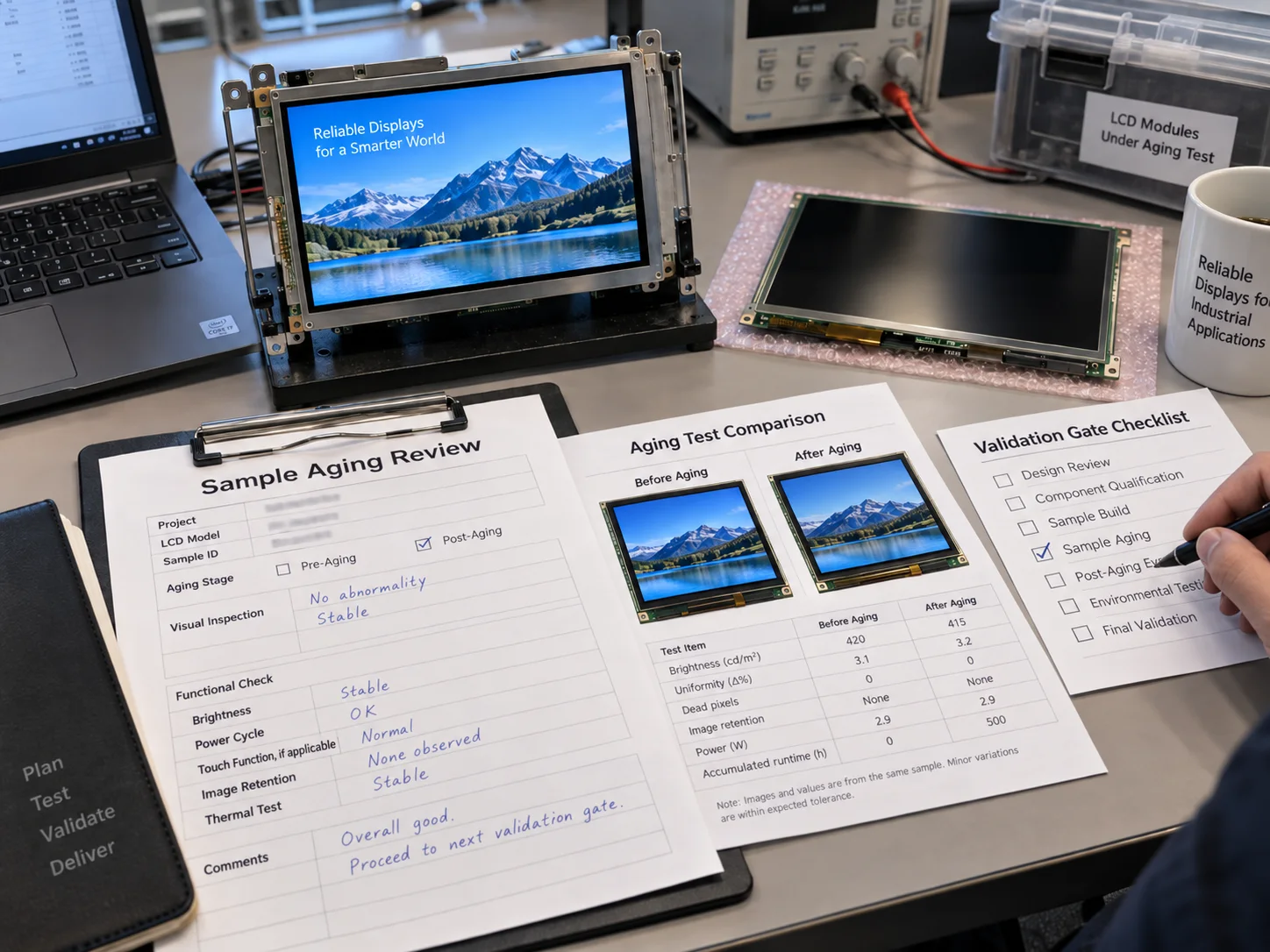
| Sample aging test | Does performance remain stable after defined operating stress? | Before-and-after measurements, power-cycle results, fault records, visual inspection |
| Final approval | Can the configuration be released as the controlled production reference? | Signed approval record, golden sample, acceptance criteria, revision and traceability data |
Combining all four activities into one informal “sample test” makes it difficult to identify the cause of a failure. A module may fail because the part itself is unstable, because the enclosure applies pressure, or because the host system supplies an incorrect power sequence. Separate gates make the evidence easier to interpret.
Define the Aging Profile Before Testing
There is no universal aging duration that proves an industrial LCD module is suitable for every application. The test profile should be connected to the equipment’s real operating conditions.
The validation team should define at least the following:
Operating duration
Record the planned test duration and explain why it is appropriate for the product risk. The duration may be based on expected daily operating hours, program criticality, previous field issues, supplier data, or an agreed internal qualification method.
A longer test is not automatically a better test. The conditions must remain controlled, and the measured outputs must be relevant to the approval decision.
Display content
Static content, high-contrast graphics, warning icons, and fixed status areas may create different risks from changing video or mixed graphical content. The test plan should identify the content pattern, percentage of fixed areas, brightness setting, and frequency of screen updates.
For applications with persistent menus or status screens, image-retention behavior should be assessed separately from ordinary continuous operation.
Brightness and backlight drive
Brightness settings influence power consumption, temperature, and backlight stress. The test should record the input signal, brightness setting, backlight current where applicable, and any dimming or enable-control behavior.
A sample operated at a low laboratory brightness may not represent the thermal or optical condition of the production design.
Temperature and enclosure condition
The module should be tested at temperatures related to the intended application. When possible, the production-intent enclosure, cable routing, mounting method, and nearby heat sources should be included.
Storage temperature should not be confused with operating temperature. A module specification may permit storage across a broad range while defining a narrower range for powered operation.
Power cycling
Continuous operation can miss failures associated with startup and shutdown. The test plan should define the power-cycle count, off-time, startup sequence, reset behavior, and display content during restart.
This is particularly important when the LCD module depends on specific timing between logic power, backlight power, reset signals, or host initialization.
What to Measure Before and After Aging
Aging is only useful when the results can be compared. The same test setup, instrument conditions, signal source, and measurement locations should be used before and after the test.
The measurement set may include:
- Luminance at defined points
- Luminance uniformity
- Color or chromaticity values where relevant
- Visible flicker or unstable output
- Startup time and first-image behavior
- Power consumption and current draw
- Image retention after static content
- Touch accuracy, response, and false-touch behavior
- Connector and FPC condition
- Mechanical fit and evidence of pressure-related distortion
- Bright pixels, dark pixels, lines, stains, bubbles, or other visible defects
- Error logs from the host controller or driver board
Not every project requires every measurement. However, each selected measurement should have an acceptance limit, test method, responsible owner, and disposition rule.
The Custom LCD Module Acceptance Criteria for OEM Procurement provides a useful framework for turning general quality expectations into measurable pass/fail criteria. For sample aging, the key addition is a before-and-after comparison under controlled conditions.
How to Investigate an Aging-Test Failure
A failure after aging should not automatically be classified as a defective LCD module. The investigation should first identify when and how the failure occurred.
A practical failure record should include:
- The exact module part number and revision
- Sample serial number or batch information
- Host controller, firmware, cable, and power-supply identification
- Test start time and environmental conditions
- Display content and brightness setting
- The first observed symptom
- Whether the failure was repeatable after cooling or restarting
- Photographs or measurement records
- The suspected failure location
- The required corrective action and retest result
For example, a brightness change may relate to the backlight, power supply, thermal condition, or measurement setup. A startup problem may be caused by the module, controller timing, reset sequence, or cable connection. A touch failure may originate in the sensor, controller firmware, grounding, cover stack, or enclosure pressure.
Root-cause analysis is more reliable when the aging test includes an unmounted reference sample and a production-intent mounted sample. This comparison can help distinguish module-level behavior from system-level integration effects.
Include Aging Requirements in the RFQ
Sample aging should not be introduced only after a supplier has delivered samples. The RFQ should identify the expected validation responsibility and the evidence required before approval.
Relevant RFQ questions include:
- Which aging or reliability data exists for the proposed configuration?
- Does the data apply to the exact module, backlight, touch layer, and controller revision?
- What operating conditions were used during the test?
- Which measurements were recorded before and after testing?
- Can supplier samples be identified by part number and batch?
- How are material, component, or production-location changes communicated?
- What retesting is required after an engineering change?
- Which aging tests must be repeated during pilot production?
- How will failures, deviations, and corrective actions be documented?
Supplier data can support planning, but it should not automatically replace application-level validation. The final equipment may impose different thermal, mechanical, optical, or electrical conditions.
How Miqidisplay Can Support the Validation Stage
Miqidisplay presents TFT LCD display modules for component-level OEM integration. For a project in which sample aging is part of the approval plan, the relevant technical discussion should cover the exact module configuration, operating conditions, interface, backlight requirements, touch structure if applicable, and intended mounting environment.
When a project requires changes to cable length, connector position, pin definition, touch components, cover glass, bonding, or backlight parameters, the custom display solutions page can be used as a starting point for defining the required configuration. Any customized module should receive controlled drawings and a revised specification before aging begins.
Sample Aging Gate Checklist
Before closing the aging stage, the project team should confirm:
- The tested module part number and revision are recorded.
- The test setup matches the approved host electronics.
- The production-intent mounting condition has been included where relevant.
- Operating duration and environmental conditions are documented.
- Brightness, content, power, and cycling settings are controlled.
- Before-and-after measurements are available.
- Acceptance limits were defined before reviewing the result.
- Any failure has a documented root-cause investigation.
- The approved sample remains traceable to the test records.
- Changes to the module or supplier process trigger a defined retest decision.
FAQ
Is sample aging the same as final product reliability testing?
No. Sample aging is one validation stage for the LCD module configuration. It may reveal early instability or performance drift, but it does not replace the complete reliability program for the finished product.
How long should an industrial LCD sample be aged?
There is no universal duration. The project should define the duration according to operating hours, environmental risk, application criticality, supplier evidence, and the intended qualification method.
Should aging be performed before or after enclosure integration?
Both conditions may be useful. An unmounted test helps examine module behavior, while a production-intent mounted test reveals thermal, pressure, cable, and optical effects created by the equipment design.
Does a sample that passes aging guarantee long-term field life?
No. A passing result shows that the sample met the defined criteria under the tested conditions. It does not create an unconditional lifetime guarantee or eliminate the need for production control and change management.
Should aging be repeated after a supplier change?
The retest decision should depend on the nature and risk of the change. Changes to the panel, backlight, driver IC, FPC, connector, touch layer, materials, process, or production location may require renewed evaluation.
Plan an Industrial LCD Sample Aging Validation Review
For an industrial LCD sample aging review, contact Miqidisplay with the module part number, controlled datasheet, host interface, enclosure condition, brightness setting, operating temperature, expected daily operating hours, static-content profile, sample quantity, and proposed aging criteria. This information helps the technical team review the sample configuration, identify the relevant validation evidence, and define the next qualification step before production approval.
Email: mary@miqidisplay.com
WhatsApp: +86 189 6801 5464; +44 07892800850