





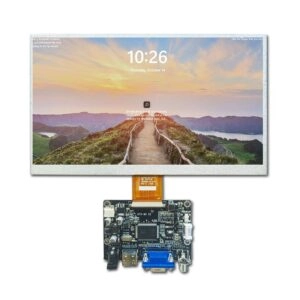
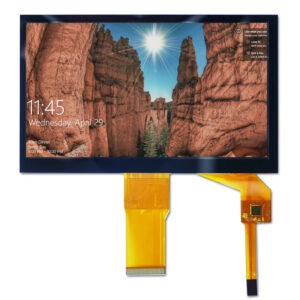


Choosing between an original LCD panel and an alternative display module is not simply a price comparison. It is a qualification decision involving mechanical fit, electrical compatibility, optical performance, environmental limits, validation effort, and supply continuity.
An original panel preserves an established design reference when the exact manufacturer, model, suffix, and approved revision remain available. An alternative module may support second-source planning or solve a specific integration problem, but it should not be described as compatible until the complete configuration has passed defined acceptance tests.
For OEM engineering and procurement teams, the central question is whether the proposed component can satisfy the approved requirements with controlled technical and lifecycle risk.

Original and Alternative LCD Options at a Glance
| Procurement factor | Original LCD panel | Alternative display module |
| Design reference | Exact manufacturer, model, suffix, and approved revision | Candidate mapped against the original requirements |
| Engineering changes | Normally limited when the approved baseline is preserved | May require cable, interface, firmware, touch, mounting, or enclosure changes |
| Validation effort | Potentially lower when revision and construction remain unchanged | Requires qualification of every relevant difference |
| Supply strategy | Relies on continued availability of the approved part | May establish a qualified second source |
| Documentation | Existing drawings, test records, and approval history may apply | New drawings, test records, and approval records are required |
| Best fit | Designs with narrow tolerances or limited requalification capacity | Projects with measurable criteria and resources for validation |
This comparison supports initial screening. It does not establish interchangeability or approve an alternative component.
Establish the Original LCD Panel Baseline
The original LCD panel should be defined as the exact manufacturer, model number, suffix, and revision listed in the approved bill of materials or product documentation. A shortened model name or matching screen size is not sufficient.
The baseline package should include:
- Manufacturer and complete part number
- Revision or specification date
- Controlled datasheet and mechanical drawing
- Active area, viewing area, outline dimensions, and thickness
- Interface, pinout, voltage, timing, and initialization requirements
- Backlight electrical requirements
- Brightness, contrast, viewing direction, and optical test conditions
- Operating and storage limits
- Touch, cover glass, cable, and connector configuration
- Approved sample and inspection criteria
Teams sourcing branded panels can use the existing original AUO LCD panel selection guide as a reference for model identity, mechanical fit, interface checks, samples, and revision control.
A familiar part number does not eliminate procurement risk. Labels, packing identifiers, specification revisions, and supplier documentation should still be checked before repeat orders are approved.
Treat Compatibility as a Qualification Result
An alternative display module is a candidate component intended to satisfy the original equipment requirements. It may use a different LCD cell, backlight, cable, connector, touch layer, controller, cover glass, or mounting structure.
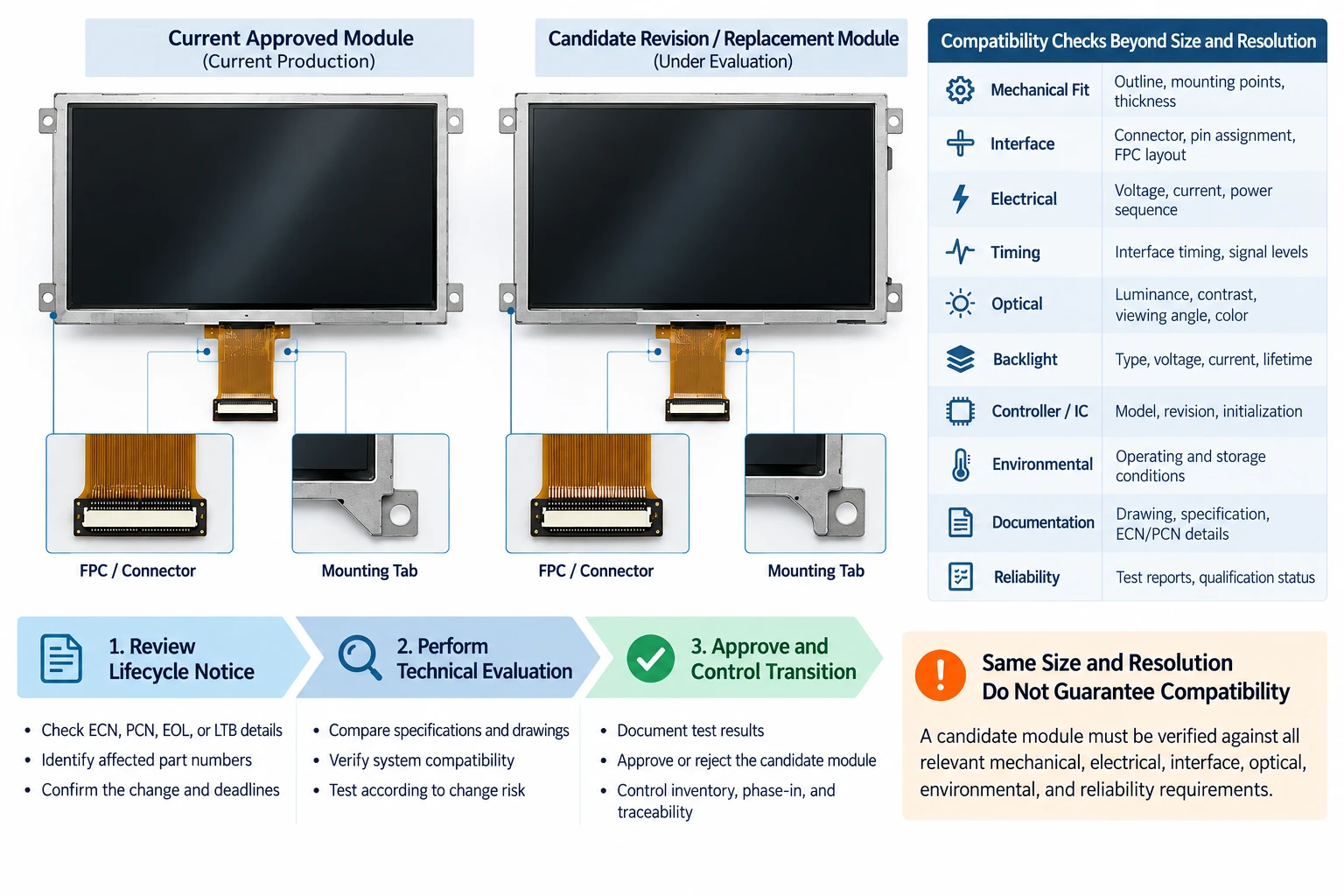
The word “compatible” should describe the outcome of validation, not an unsupported product claim. Two modules with the same diagonal size and resolution may still differ in:
- Signal mapping and pin assignment
- Logic and backlight voltage
- Pixel-clock and synchronization timing
- Connector position and orientation
- Outline dimensions and thickness
- Flexible-cable exit direction
- Viewing direction and optical characteristics
- Startup behavior and firmware requirements
- Temperature limits and thermal behavior
A candidate becomes a qualified alternative only after these differences have been documented, tested, and accepted.
Build a Requirement and Deviation Matrix
A controlled comparison should place the original specification and candidate data side by side. Each requirement can then be classified as:
- Must match:A difference is not acceptable without redesign.
- May vary within limits:The candidate can differ if it remains inside an approved range.
- Requires engineering review:The difference may be acceptable after testing or a controlled design change.
- Not documented:Supplier clarification and validation are required.
The matrix should identify the source document, value, tolerance, test method, owner, and approval status for every critical requirement.
Mechanical Qualification
Compare the active area, viewing area, outline, thickness, mounting points, rear-component height, cable exit, connector position, and required clearances. A minor dimensional difference can interfere with a bezel, gasket, bracket, enclosure wall, or cable route.
Mechanical approval should use controlled drawings with revision identifiers. Product photographs and nominal diagonal size cannot confirm fit.
Electrical and Interface Qualification
Verify the interface standard, signal mapping, lane or channel configuration, pin assignment, logic voltage, power sequence, timing, reset behavior, and backlight drive. Matching connector shapes do not prove electrical compatibility.
If a controller board is part of the assembly, qualify the panel and board together. Resolution support alone is insufficient; timing, voltage, configuration data, backlight control, and connector mapping must also agree.
Optical Qualification
Compare brightness, contrast, viewing direction, color behavior, response characteristics, and surface treatment under their stated test conditions. Minimum, typical, and maximum values should not be treated as equivalent.
Testing should use the intended cover glass, touch layer, bonding method, and equipment orientation. These elements can change reflections, perceived contrast, brightness, and viewing performance compared with a bare panel.
Environmental and Operating Qualification
Review operating temperature, storage temperature, humidity conditions, vibration, shock, orientation, duty cycle, and nearby heat sources. Missing data should be recorded as unverified rather than assumed to match the original panel.
The candidate should be tested in a representative enclosure because mounting pressure, heat accumulation, cable routing, and power conditions may affect performance.
Qualify the Alternative Module Before Approval
A practical qualification process should follow these steps:
- Freeze the original panel part number, revision, drawings, interface data, and acceptance limits.
- Record every difference between the original and candidate components.
- Decide which differences are prohibited, conditionally acceptable, or subject to redesign.
- Build samples using the intended cable, controller, touch layer, cover glass, and mounting method.
- Test mechanical fit, startup, image stability, brightness, viewing direction, touch response, temperature behavior, and representative operating conditions.
- Record test methods, results, deviations, sample identifiers, and drawing revisions.
- Approve a golden sample and define the change-notification process for production orders.
A workbench demonstration only confirms basic operation. It does not reproduce enclosure pressure, cable constraints, thermal conditions, optical layers, or production assembly.
Prepare an Alternative Module RFQ
The RFQ should identify both the original baseline and the qualification requirements for the candidate. Include:
- Original manufacturer, complete model number, suffix, and revision
- Datasheet and mechanical drawing
- Dimensions, active area, viewing area, and mounting constraints
- Resolution, interface, pinout, timing, voltage, and backlight requirements
- Brightness, viewing direction, surface treatment, and optical limits
- Touch, cover glass, cable, connector, and bonding requirements
- Operating conditions and required validation tests
- Permitted and prohibited engineering changes
- Sample quantity, forecast quantity, and destination
- Required documentation, inspection records, and change notification
- MOQ, lead time, and lifecycle information to be confirmed during quotation
This information allows suppliers to identify real differences instead of proposing a visually similar component without evidence of fit.
Control Configuration and Future Changes
Supplier evaluation for an alternative module should focus on documentation and configuration control. Buyers should confirm how drawings, samples, cables, connectors, backlights, touch components, firmware assumptions, and approved deviations are identified.
The Miqidisplay website describes original panel sourcing and custom display solutions involving cables, interfaces, connectors, circuit boards, touch additions, cover glass, backlights, and mounting features. Applicability should be confirmed for the selected component, and every approved modification should appear in a controlled drawing or specification.
Second-source approval is not complete unless repeat orders can be matched to the qualified configuration. Purchasing records should therefore identify the approved part, revision, drawings, test records, golden sample, and conditions that trigger requalification.
Conclusion
An original LCD panel provides a defined engineering baseline, but its part number alone does not guarantee revision control or future availability. An alternative display module can support second-source planning or targeted customization, but it requires documented comparison and application-specific validation.
The correct procurement decision is specification-driven. Freeze the original baseline, classify every deviation, test the complete assembly, approve a controlled sample, and establish change-notification requirements before production purchasing.
FAQs
Is an alternative display module automatically compatible?
No. Compatibility should be confirmed through mechanical, electrical, optical, environmental, and assembly-level validation.
Does matching size and resolution prove interchangeability?
No. Pinout, timing, voltage, thickness, connector position, cable direction, viewing characteristics, and backlight requirements may still differ.
When should the original LCD panel be retained?
Retaining the original is generally appropriate when the design has narrow tolerances, existing approval records remain valid, and the costs or risks of requalification exceed the sourcing benefit.
When is an alternative module worth evaluating?
An alternative may be appropriate when the project needs a second source, the original part is difficult to obtain, or a documented integration change provides a clear benefit.
Should a driver board be qualified with the LCD panel?
Yes. The combined assembly should be checked for interface, resolution, timing, voltage, connector mapping, backlight control, startup behavior, and mechanical fit.
What should be controlled after approval?
Control the module part number, revision, drawings, interface configuration, cables, controller settings, optical stack, test records, golden sample, and engineering-change process.
Request an LCD Alternative Qualification Review
Engineering and procurement teams comparing an original panel with a candidate alternative can request a Miqidisplay technical fit review. Submit the original part number and datasheet, candidate specification, drawings, interface and pinout, mechanical constraints, optical requirements, operating conditions, sample needs, and forecast quantity. These inputs support a focused compatibility review and qualification plan before a sourcing decision.
Email: mary@miqidisplay.com
WhatsApp: +86 189 6801 5464; +44 07892800850