





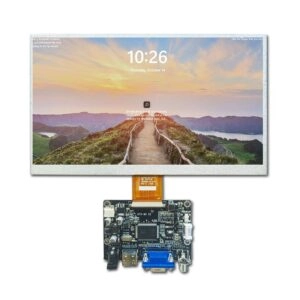
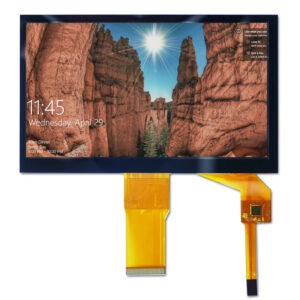


Selecting an LCD module supplier for an industrial project is a risk-management decision, not a simple component purchase. A module may remain in production for years, while specification or availability changes can affect qualification, tooling, firmware, and delivery. Evaluation should cover technical fit, manufacturing control, customization, compliance, lifecycle support, and commercial stability.

Define the Display Requirement Before Comparing Suppliers
Supplier comparisons require a complete project specification. The request for quotation should define active area, outline dimensions, resolution, aspect ratio, interface, connector location, power limits, operating and storage temperature, brightness, contrast, viewing direction, response time, touch requirements, and expected annual volume.
Translate the Operating Environment into Measurable Criteria
Industrial stresses may not appear during bench testing. Temperature cycling can affect liquid-crystal response, adhesives, polarizers, connectors, and backlight performance. Humidity can affect optical layers and insulation; vibration and shock can expose weak mounts or cable terminations.
A qualified LCD module supplier should provide operating limits, test methods, acceptance criteria, and supporting reports. “Industrial grade” claims should be tied to defined conditions. Validation may address temperature, damp heat, vibration, shock, and extended operation under representative electrical loads.
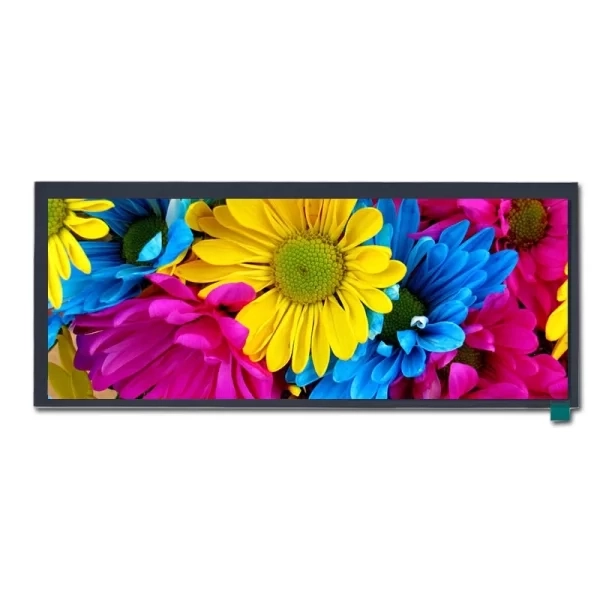
Confirm Optical Performance Under Real Conditions
Brightness alone does not determine readability. Evaluation should cover contrast, viewing angle, surface treatment, color consistency, uniformity, reflection control, and temperature performance. IPS technology may suit wide-angle applications, while other TFT structures may fit controlled viewing geometry and tighter cost targets.
Samples should be evaluated inside the intended enclosure with the planned cover lens, bonding structure, ambient lighting, and power configuration. This prevents approval under unrepresentative conditions.
Audit Quality Management and Manufacturing Control
Certificates help, but process evidence matters more. Evaluation should examine incoming-material control, assembly, inspection, nonconforming-product handling, corrective action, calibration, training, and final release.
Review Traceability and Change Management
Industrial buyers need traceability from finished modules to critical materials and production batches. The supplier should identify the panel source, driver IC, flexible cable revision, backlight configuration, connector, polarizer, adhesive, touch structure, and inspection record.
The supply agreement should define advance notice for substitutions, process or tooling changes, production transfers, and end-of-life events. Unapproved substitutions can create compatibility problems even when headline specifications remain unchanged.
Examine Defect Criteria and Reliability Data
Inspection standards should define acceptable and unacceptable bright or dark pixels, particles, scratches, light leakage, mura, line defects, connector damage, and dimensional deviation. Sampling plans, inspection lighting, viewing distance, inspection time, and defect zones should be documented.
Reliability evidence should match the proposed module. Useful records include temperature, humidity, vibration, operational life, electrostatic-discharge, and failure-analysis results. Strong suppliers can explain failure mechanisms, corrective actions, and recurrence-prevention controls.
Evaluate Engineering and Customization Capability
Industrial projects may require cable changes, connector selection, pin assignment, interface adaptation, backlight parameters, touch integration, cover glass, optical bonding, mounting features, or PCB changes.
Assess Design Review Quality
A capable LCD module manufacturer should review the complete application specification before recommending a part. Engineering feedback should identify interface limits, signal-timing risks, tolerance conflicts, thermal concerns, optical trade-offs, and lifecycle constraints.
The sample process should include controlled drawings, revision numbers, datasheets, interface definitions, and approval records. Golden samples should be retained. Differences between prototype and mass-production construction should be disclosed before qualification.
Verify the Path from Prototype to Volume Production
Prototype success does not prove production readiness. Procurement teams should examine pilot-build control, process transfer, first-article inspection, and methods for locking approved materials.
Capacity planning should cover expected and peak demand, yield assumptions, safety stock, and recovery plans for constrained components. The strongest supplier aligns engineering resources, production control, and material planning with the project forecast.
Measure Supply Continuity and Commercial Risk
Industrial equipment often has a longer lifecycle than the components inside it. Evaluation should include product longevity, last-time-buy procedures, replacement planning, minimum order quantities, lead-time stability, and inventory policy.
Calculate Total Cost, Not Unit Price
A low quotation can become expensive through repeated sampling, redesign work, excess inventory, inconsistent quality, delayed production, or emergency sourcing. Total cost should include tooling, engineering charges, samples, qualification, logistics, payment terms, yield loss, documentation effort, and future changes.
Transparent pricing should distinguish standard module cost, customization, tooling, testing, packaging, and volume breaks. Ambiguous quotations make later cost control difficult.
Evaluate Communication as an Operational Capability
Response speed matters, but response quality matters more. Technical answers should be supported by drawings, specifications, or test evidence. Commercial communication should state responsibilities, revision status, and lead times.
The handling of a failed sample often reveals more than a sales presentation. A structured root-cause report, containment action, corrective plan, and verification result indicate a mature operating process.
Build a Cross-Functional Supplier Scorecard
A robust decision should combine engineering, quality, procurement, operations, and compliance input. Technical scoring can cover optics, interface compatibility, mechanical integration, temperature range, and customization. Quality scoring can cover process control, traceability, defect standards, reliability evidence, and corrective action. Commercial scoring can cover total cost, lead time, capacity, lifecycle support, and contract terms.
Weighting should reflect project risk. A long-life industrial instrument may prioritize change control and continuity, while a compact embedded product may prioritize mechanical customization and power consumption. Final approval should require closure of critical risks rather than reliance on an average score.
Common Warning Signs During Supplier Qualification
Warning signs include incomplete datasheets, inconsistent drawings, undefined defect criteria, unexplained specification changes, vague compliance statements, unsupported lifetime claims, and quotations that omit tooling or customization charges. Another concern is a recommendation based only on size and resolution without discussion of interface timing, thermal conditions, optical stack, or lifecycle.
Poor documentation control during sampling indicates higher revision risk during mass production.
FAQ
What documents should an industrial LCD module supplier provide?
A qualification package typically includes a controlled datasheet, mechanical drawing, interface specification, inspection criteria, compliance declarations, reliability reports, material information, packaging specification, and change-notification procedure.
How many samples are needed before supplier approval?
The quantity depends on project risk and validation scope. Samples should cover engineering evaluation, enclosure integration, environmental testing, pilot production, and retained reference units. Multiple production lots provide stronger evidence than one lot.
Which certifications matter when evaluating LCD module suppliers?
Relevant evidence may include a recognized quality-management system, environmental-management controls, and market-specific substance compliance. Certificates should be verified for scope, site, issuing body, and validity, then supported by process records and product documentation.
Should a custom LCD module be selected early in development?
Early engagement reduces redesign risk because dimensions, interfaces, optical requirements, cable routing, touch structure, and lifecycle expectations can be reviewed before enclosure and electronics decisions become difficult to change.
Partner with an Industrial LCD Module Manufacturer and Supplier
Miqidisplay is an advanced display technology manufacturer and solutions supplier serving business buyers with LCD, TFT, and IPS display modules and specialized accessories. The company focuses on screen modules rather than finished equipment and supports standard selection, cable and connector customization, interface options, cover glass, touch integration, optical bonding, backlight adjustment, and project-specific engineering. With documented quality controls, international compliance support, broad module choices, and sales consultation for custom requirements, Miqidisplay can support OEMs, equipment manufacturers, engineering teams, and industrial sourcing programs seeking a qualified long-term display partner.
For technical evaluation, sample planning, custom LCD module development, or a commercial quotation, procurement and engineering teams can contact the Miqidisplay sales team or send project specifications to mary@miqidisplay.com. General support inquiries can be directed to sale@miqidisplay.com. Business inquiries are also accepted by phone or WhatsApp at +86 189 6801 5464, with an additional WhatsApp contact available at +44 07892800850.