





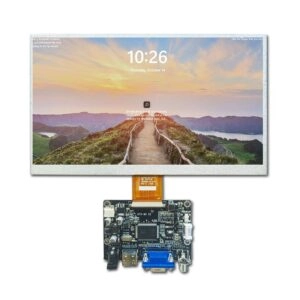
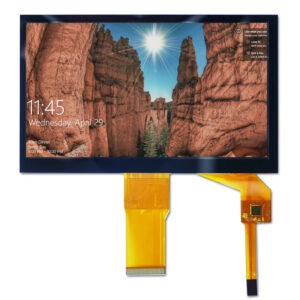

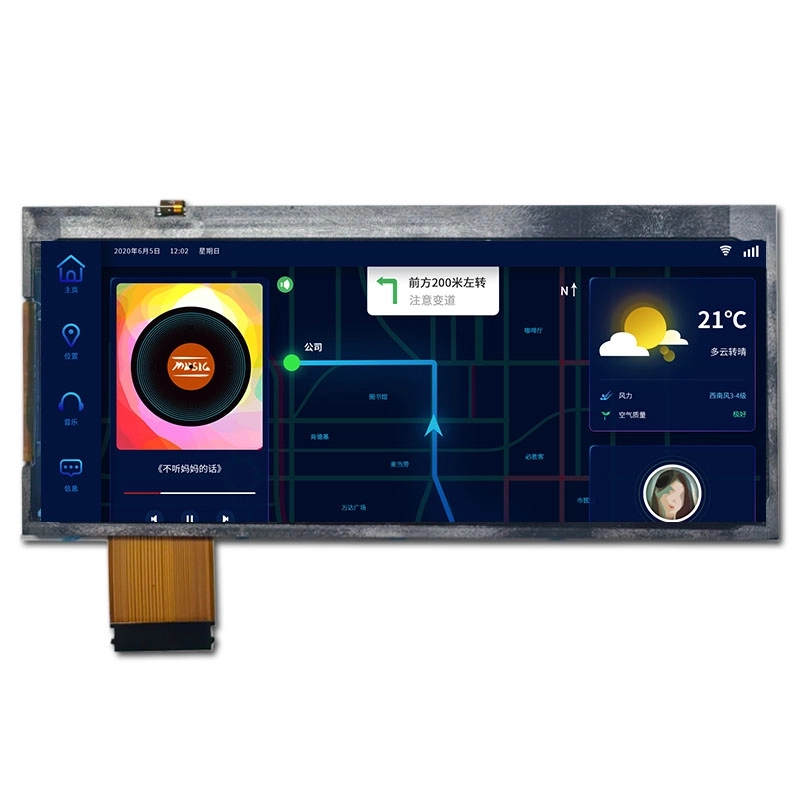
TFT LCD modules are key screen components used in many professional products. Their usual lifespan, set mainly by the LED backlight unit, often falls between 30,000 and 50,000 hours in good conditions. Proper operating conditions help support stable screen performance and longer backlight life.
This full guide looks at the main factors that affect TFT LCD life and gives useful ways to improve it.
Operating Conditions
Good operating conditions build the base for longer TFT LCD module life. Main factors cover temperature, humidity, power stability, and backlight control. Following maker rules stops fast aging and keeps steady work in tough places.
Temperature Effects on Lifespan
Temperature has the biggest effect on TFT LCD strength. The best room range sits near 20°C to 25°C, where wear happens most slowly. Changes, especially high heat, speed up many failure ways.
Liquid Crystal Layer Darkening and Chemical Degradation
Liquid crystal materials act as organic compounds with traits between liquids and solids. Each mix has a set clearing point (Tni), usually 60°C to 70°C for normal panels and higher for industrial types. Going over this point makes the molecules lose their ordered nematic phase. They shift to an isotropic state and cause display failure.
Higher temperatures also lower the voltage holding ratio (VHR) as extra ions grow more active. For each 10°C rise, conductivity may go up by 1.5 to 2 times. This leads to flicker, image sticking, or lasting harm above 60°C. Industrial-grade panels with better materials give more resistance in hot settings.
Polarizer Yellowing and Shrinkage
Polarizers, made of PVA films with iodine and TAC protective layers, stand as weak parts. Long time at temperatures near 80°C causes iodine loss or oxidation. This results in yellowing, lower light pass (from about 42% to 38% or less), and cooler color temperature.
Heat expansion differences cause shrinkage and corner light leaks as the polarizer pulls back from the glass base. Good heat control and choice of high-temperature polarizers reduce these problems in long use.
Backlight Bead Brightness Attenuation
LED backlights set the full module lifespan through light maintenance. This follows an exponential link with junction temperature (Tj). At 25°C room temperature, Tj stays low (45°C–55°C). It supports up to 50,000 hours. At 70°C, life falls below 10,000 hours because of phosphor aging, epoxy darkening, and possible wire bond breaks.
Current reduction becomes important at higher temperatures. Cutting drive current in a straight line above 50°C stops heat loss and keeps quantum efficiency. Picking backlights with enough extra room lets operation at 60–70% level for needed brightness. This greatly increases service life.
Inconsistent Expansion of Glass and Housing
Material expansion rates differ a lot: glass at 3–4 ppm/°C, aluminum at 23 ppm/°C, and plastics up to 50–100 ppm/°C. Not enough expansion space (ideally 0.3–0.5 mm) in frame designs creates mechanical stress during temperature changes. This produces mura effects or, in bad cases, glass cracks or ITO breaks.
Strong mechanical design with right clearances and stress-relief parts stops these issues in changing-temperature industrial setups.
Slow Response at Low Temperatures
Low temperatures raise liquid crystal thickness. This extends response times a lot—from 15–25 ms at 25°C to 300–500 ms at –20°C. Threshold voltage changes also cut contrast. While often not destructive, these conditions may overload driver circuits or block startup in very cold spots. Wide-temperature panels handle these issues well.
Humidity Corrosion Protection
Humidity control under 90% RH (non-condensing) stops electrochemical movement and corrosion. High moisture helps dendrite growth on PCBs and FPCs, ITO layer wear, and polarizer separation.
Corrosion of Glass Conductive Layer
Moisture entry with drive voltages eats away thin ITO layers (1000–1500 Angstroms). This raises resistance and causes line failures or dead columns. Edge sealing and environment protection improve resistance.
Polarizer Blistering and Peeling
Hydrophilic PVA takes in moisture. This leads to hydrolysis, alignment issues, and PSA adhesive failure at high temperature/humidity mixes (e.g., 60°C/90% RH). This shows as bubbles or lifting.
Voltage and Current Stability
Steady power supply is very important. Logic voltage (typically 3.3V) accepts little change (±0.3V), with ripple under 50 mV. Overvoltage risks gate oxide breakdown, while undervoltage causes lockouts.
Correct Power-On Sequence
Power must come before signals by 0–50 ms. Backlight activation waits about 200 ms. Reverse order on power-off. Breaks cause latch-up or visual problems.
Surge Current Protection
Inrush currents at startup (2–3A peaks) need soft-start circuits. These prevent voltage drops and system resets.
Backlight Voltage Fluctuation
Steady backlight voltage (12V or 24V) stops flickering and driver harm from spikes. Good filtering and regulation matter a lot.
Backlight Driving Methods
Constant current (CC) driving works better than constant voltage. It keeps steady output despite temperature or voltage changes. PWM dimming (200 Hz–20 kHz) or hybrid ways balance flicker, noise, and color accuracy. Soft-start and temperature-feedback reduction further protect LEDs.
FAQ
What is the typical lifespan of a TFT LCD module?
Under good conditions (around 25°C, controlled humidity, and proper power), industrial TFT LCDs often reach 30,000 to 50,000 hours. Backlight performance mainly limits them.
How does high temperature affect TFT LCD displays?
High temperature can speed up LED backlight decay, polarizer yellowing, liquid crystal degradation, adhesive aging, and mechanical stress. It may also reduce brightness and shorten the working life of the TFT LCD module.
Can low temperatures damage TFT LCD modules?
Low temperatures usually cause short-term performance issues like slow response instead of lasting harm. Yet extreme cold may affect startup.
Work with a TFT LCD Screen Supplier
Miqidisplay provides TFT LCD display modules for industrial equipment, medical devices, automotive systems, embedded products, outdoor devices, and professional applications. We support options such as high brightness, wide-temperature operation, touch panel integration, interface customization, connector adjustment, cover glass, optical bonding, and custom backlight solutions.
If your project requires a standard TFT LCD screen or a customized LCD module for harsh operating conditions, Miqidisplay can help recommend a suitable TFT LCD screen module based on size, brightness, interface, temperature range, structure, and lifetime requirements.
Click the Contact Miqidisplay page to send us your project requirements and get a tailored TFT LCD display recommendation from our engineering and sales team.