





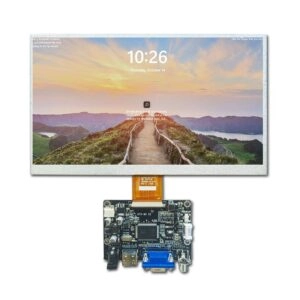
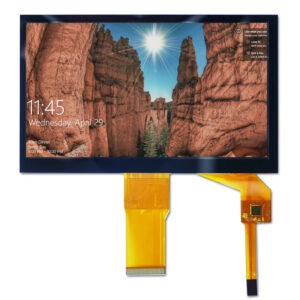

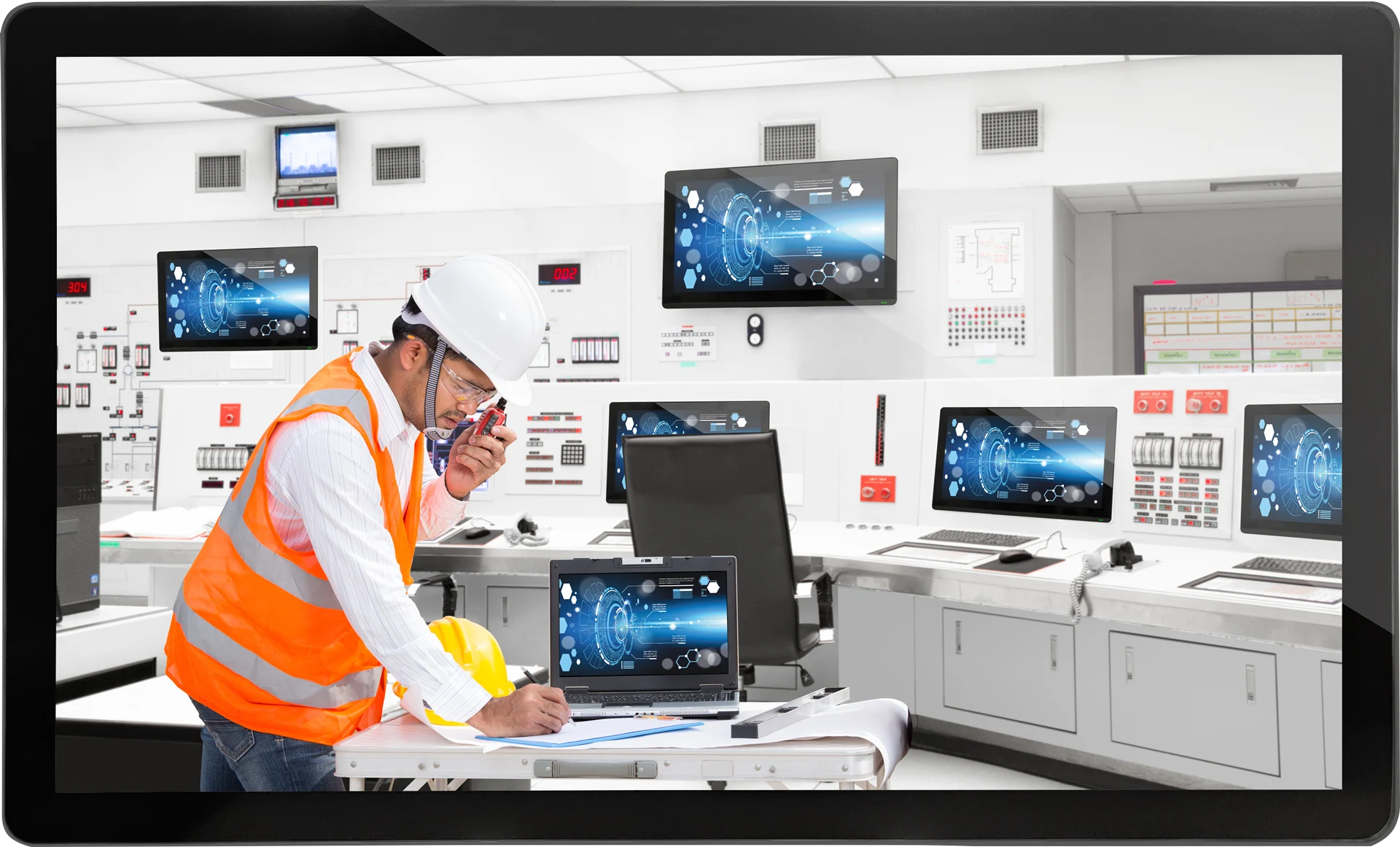
Industrial computer monitors are special high quality display equipment for critical applications in industry. Selecting an optimal monitor requires a thorough check list of characteristics such as display, interfaces, mounting options and protection features. Our guide helps you to choose an industrial monitor which is reliable, safe in operation and highly productive.
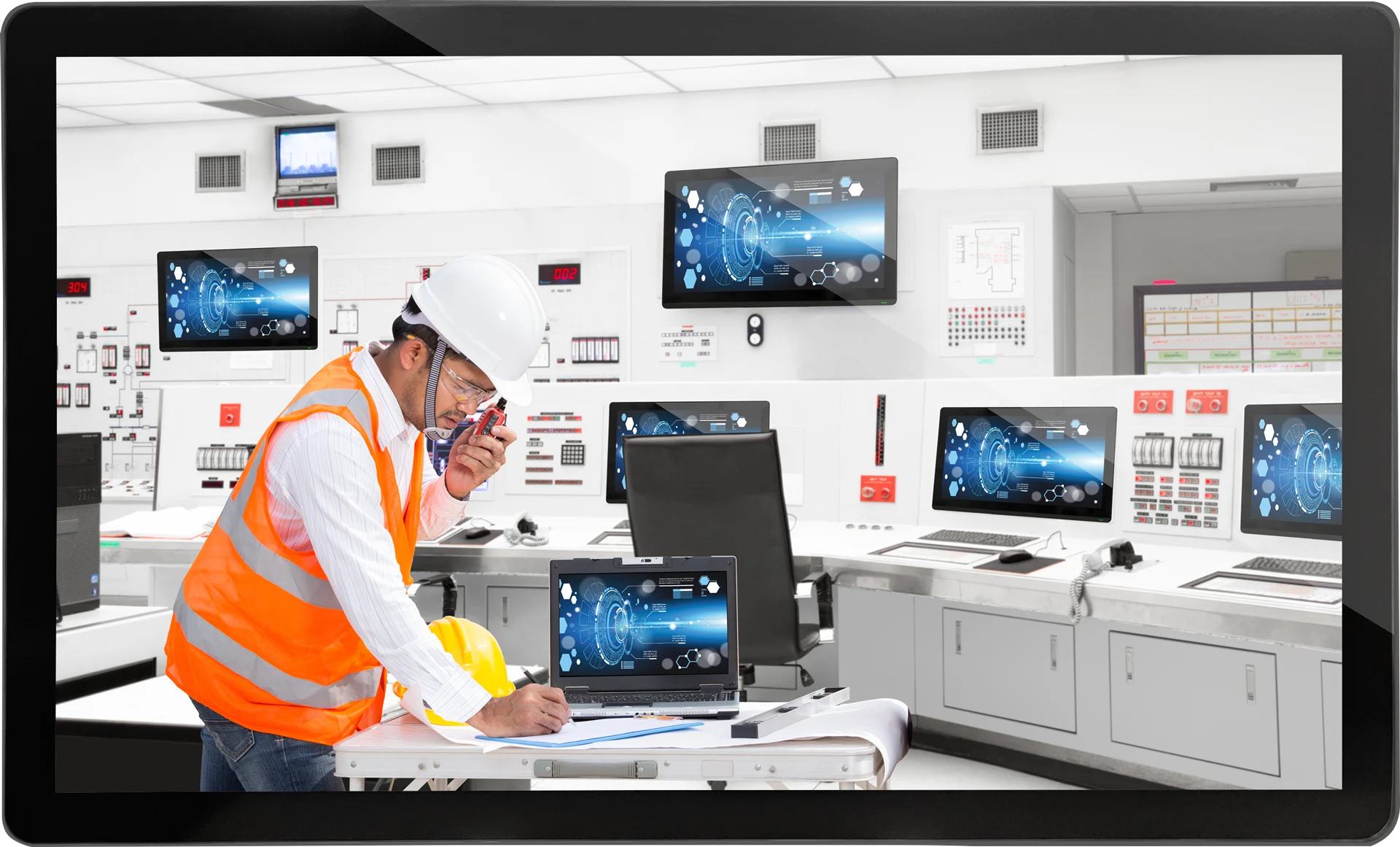
Key Differences Between Consumer and Industrial Monitors
There is an important distinction to make between industrial monitors that are found in production lines on factory floors, and commercial/ consumer monitors found in homes, offices, etc. We highlight key differences between industrial and consumer displays: durability/ reliability and environmental ruggedness, plus industrial-grade integration options.
Industrial monitors are built with rugged outer cases typically made of steel or stainless steel. As opposed to consumer monitors which are encased in plastic, Industrial monitors have reinforced glass and are put through testing for shock, vibration and for resistance to contamination. Additionally the temperature range within which the monitor can operate is often extended to -20°C up to +70°C and even more. Thus Industrial monitors are suitable for use in production lines where temperatures can fluctuate or be extremely high or low.
Most industrial control panels use Ingress Protection ratings such as IP54 to IP66 for protecting against dust, water and cleaning with high pressure washes as opposed to the minimal protection afforded by typical consumer units. Connectivity includes serial ports, Ethernet, USB and industrial specific interfaces to connect to control systems, PLCs and industrial sensors. Hazardous location ratings allow safe use in locations with combustible dust or gases.
The lifespan of the components used in these solutions has increased dramatically. The parts are designed for 24/7 operation and can last up to 10 years or more. In contrast to typical consumer monitors that have a lifespan of 3-5 years and need to be replaced frequently. The solutions offer high availability and excellent visual quality even in harsh environments and with minimal down time.
Key Selection Criteria for Industrial Monitors
Effective selection between projectors depends on five key characteristics: visual quality, interaction, durability, mounting and system integration.
Visual Performance
BenQ industrial panel solutions are designed to support a wide variety of work environments, and come in a range of sizes from 10 inches up to 24 inches or larger. Our industrial display solutions deliver Full HD (1920×1080) or higher, including 4K and above in select configurations. They are able to clearly display engineering drawings, industrial data, as well as industrial level video. A high brightness of 250 to 1000 nits or above allows for good visibility in a wide variety of industrial environments and with varying levels of ambient light, and for especially bright environments and outdoor usage, we have high brightness industrial display solutions.
Contrast ratios of 800:1 to 1500:1 or greater deliver crisp text and graphics. Wide viewing angles, often 178 degrees via IPS technology, prevent color distortion or washout for operators viewing screens from multiple positions. Calibration controls allow fine-tuning for specific ambient conditions.
Touchscreen Technologies
Interactive Touch Functionality – turn your monitor into a interactive interface. We support Resistive Touch and Capacitive Touch. In demanding environments such as production or assembly lines with protective gloves in use, Resistive Touch is the better choice, as it is highly durable and works even with gloves on. With its high clarity and multi touch capability, Capacitive Touch is ideal for gesture and motion based control. With electrical field sensing it recognizes even smallest changes.
The advanced surface acoustic wave technology used in this touchscreen provides precise recognition, even in dirty, oily or moist conditions. Precise touch recognition of 2-3mm ensures accurate operation. Touchscreens can be supplied with almost any touch overlay to suit most applications.
Ruggedness and Environmental Protection
Enclosures must withstand dust, liquids, impacts, and temperature extremes. IP65 or IP66 ratings provide robust defense against ingress, while high IK ratings ensure resistance to mechanical shocks. Wide-temperature operation and fanless designs prevent failures from airborne particles clogging vents.
Our products can be equipped with conformal coating and with special connectors like M12 to be highly reliable even in humid or corrosive environments. All products are tested for vibration and shock to guarantee durability on mobile machinery or in high-vibration areas.
Mounting Requirements
Our range of mounting options mean you can mount your products in the way that is most suitable for your facility. Panel mounting is typical for installating products within control panels, offering a flush and secure solution. Alternatively, our VESA arms or stands can be used to offer flexible and free standing mounting options. Rack mounting allows for the most dense of installations within equipment cabinets. A selection of pedestal or custom mounting brackets are also available for products that require to be moved from place to place. The most suitable option will depend upon the constraints of the space available, the ergonomics and the level of maintenance required.
Connectivity for Industrial Networks
Versatile inputs ensure compatibility with existing infrastructure. Video interfaces like HDMI, VGA, DVI, and DisplayPort connect to various computing platforms. Ethernet and USB ports facilitate data exchange, remote monitoring, and peripheral integration. Serial connections (RS-232, RS-422, RS-485) link legacy systems. Modular expansions support protocols essential for automation.
Hazardous Location Ratings
In environments where flammable substances are present, it is crucial for your monitors to hold a certification such as Class I Div 2 or equivalent zone rating. This will enable the safe operation of the monitors within environments where explosive gases, vapors or dust may be present. Furthermore, the monitor must hold the exact same rating as the site classification in order to avoid potential risks as well as ensure full compliance with relevant regulations.
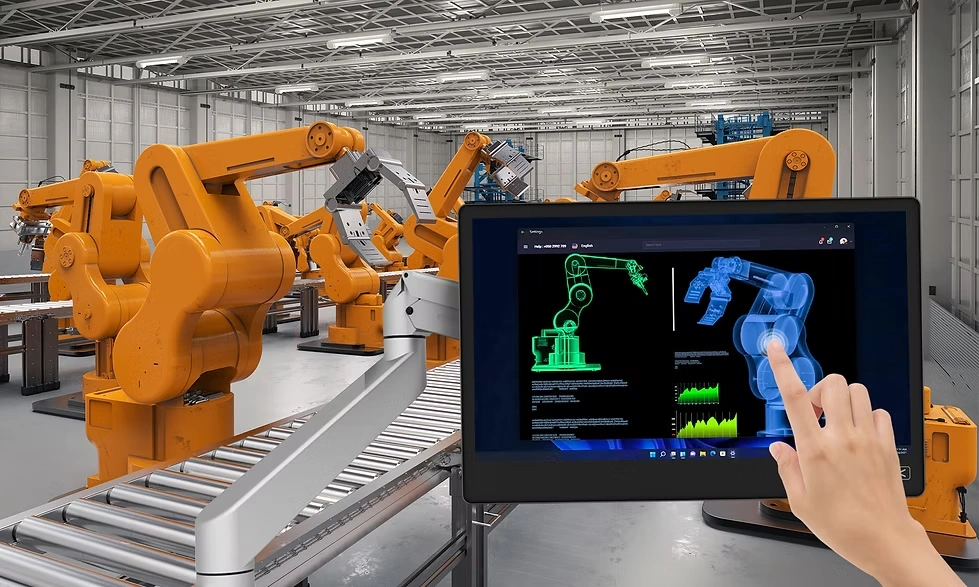
Industrial Monitors vs. Panel PCs
Industrial monitors are screens that display output from external computers or controllers. They are primarily used for visualization and can be equipped with touch functionality. Industrial panel PCs are all-in-one systems consisting of computing hardware. They are used for process control, data processing and for the execution of software.
Panel PCs suit standalone or edge-computing applications with built-in processors, such as Intel Celeron or Core series, and support for multiple I/O options. Monitors excel in distributed systems where centralized computing pairs with multiple display points. Both contribute to manufacturing efficiency, with choices driven by control complexity and system architecture.
Factors Influencing Long-Term Performance
Thermal management remains critical. Fanless operation reduces maintenance in dusty settings, relying on efficient heat dissipation designs. Backlight longevity, often using LED technology, affects overall service life and energy consumption. Customization of driver boards, interfaces, and enclosures tailors solutions to unique production demands.
Ongoing evaluation of current application requirements including software compatibility and future growth needs ensures that MRC solutions continue to deliver long term ROI by minimizing the number of replacements and instances of down time.
Conclusion
To pick the optimal industrial computer monitor for your needs, the specifications of the monitors have to be matched to the specific demands of your production. Only high-resolution monitors with robust touch functionality, excellent sealing and plenty of connection options are of real value.
Frequently Asked Questions
What are industrial computer monitors?
Industrial computer monitors are specialized displays built for harsh manufacturing environments, offering enhanced durability, wide temperature tolerance, and integration features compared to standard consumer screens.
What to consider when buying an industrial monitor?
When selecting a monitor, the manufacturer has to consider several features like display size and resolution, screen brightness and viewing angle, touchscreen technology, IP and IK rating, operating temperature, mounting options, interfaces, and also if it can be used in a hazardous area.
Partner with a Trusted Industrial Display Manufacturer and Supplier
If you are a company looking for a quality visualization partner then you will benefit from working with a display manufacturer/supplier with lots of experience and knowledge in the industry. Miqidisplay supply high quality TFT LCD displays, industrial monitors and custom panel PCs that can be used within your production environment. We have extensive OEM/ODM experience and can design and supply a solution that meets your exact requirements, such as custom interfaces, touch screens, ruggedized enclosures and operation over a wide temperature range.
Makers of equipment and system integrators can count on one-stop shops offering standard products and fully customized solutions, all thoroughly checked for quality and bearing certificates granted worldwide. For industrial monitors or panel PCs for industrial applications that are needed for a longer period of time, Miqidisplay is your partner. Here you will receive a quote for your special requirements fast and competent. As a manufacturer of displays for industrial applications and supplier we are the right partner for a scalable and efficient implementation in your production.