





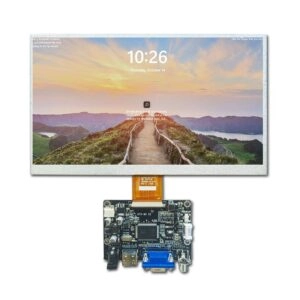
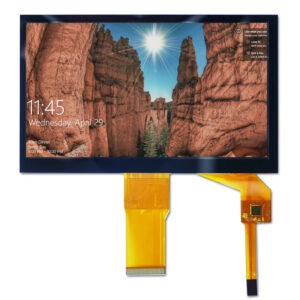

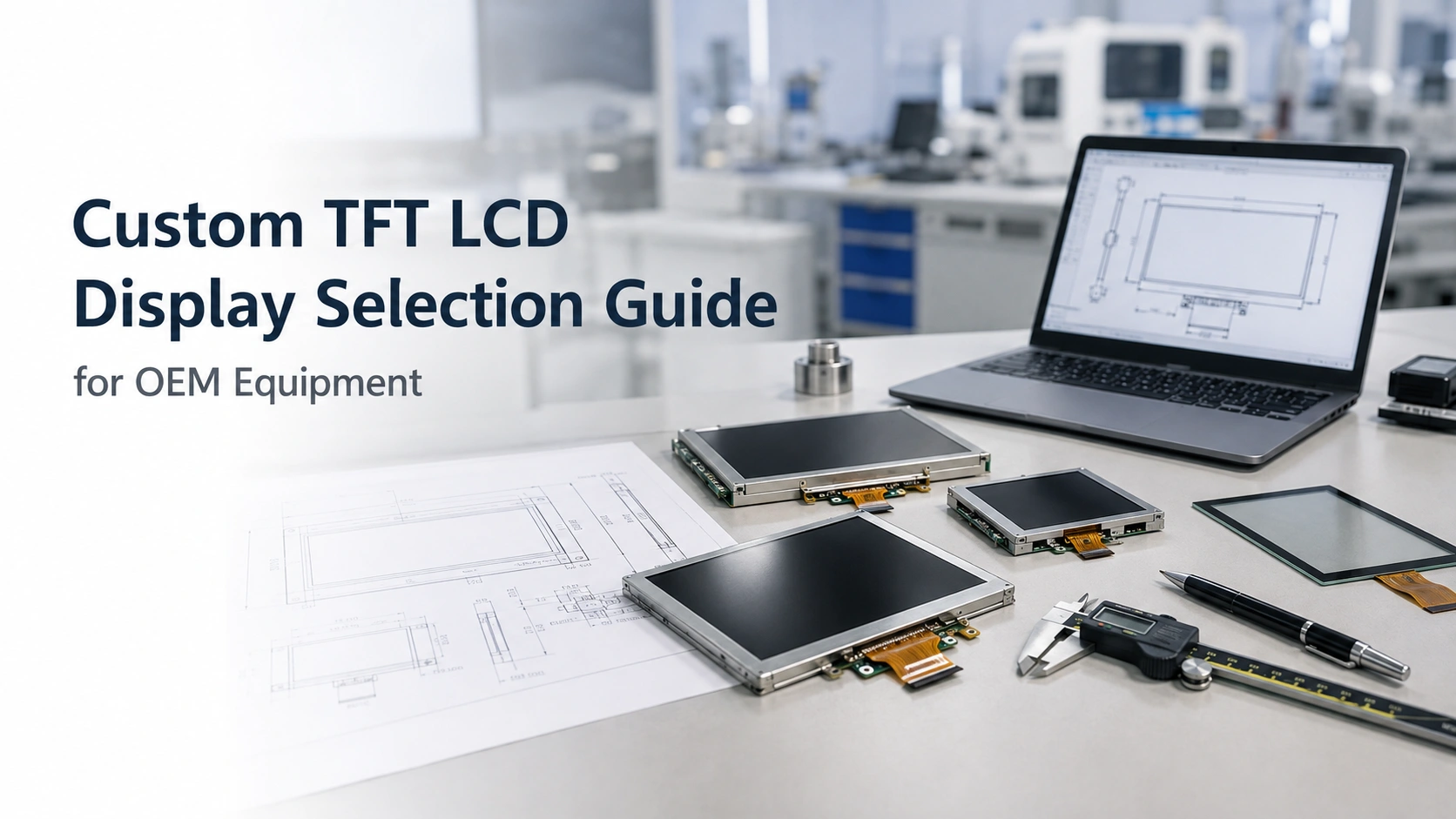
Choosing a custom TFT LCD display for OEM equipment requires more than matching diagonal size and resolution. The module must fit the product enclosure, communicate with the control system, meet optical requirements, and remain practical to source across the product lifecycle. Engineering, procurement, and project teams should therefore evaluate the display as an integrated component rather than as an isolated screen.
This guide explains the main selection criteria, the information to prepare for an RFQ, and how to assess an OEM display supplier before approval.
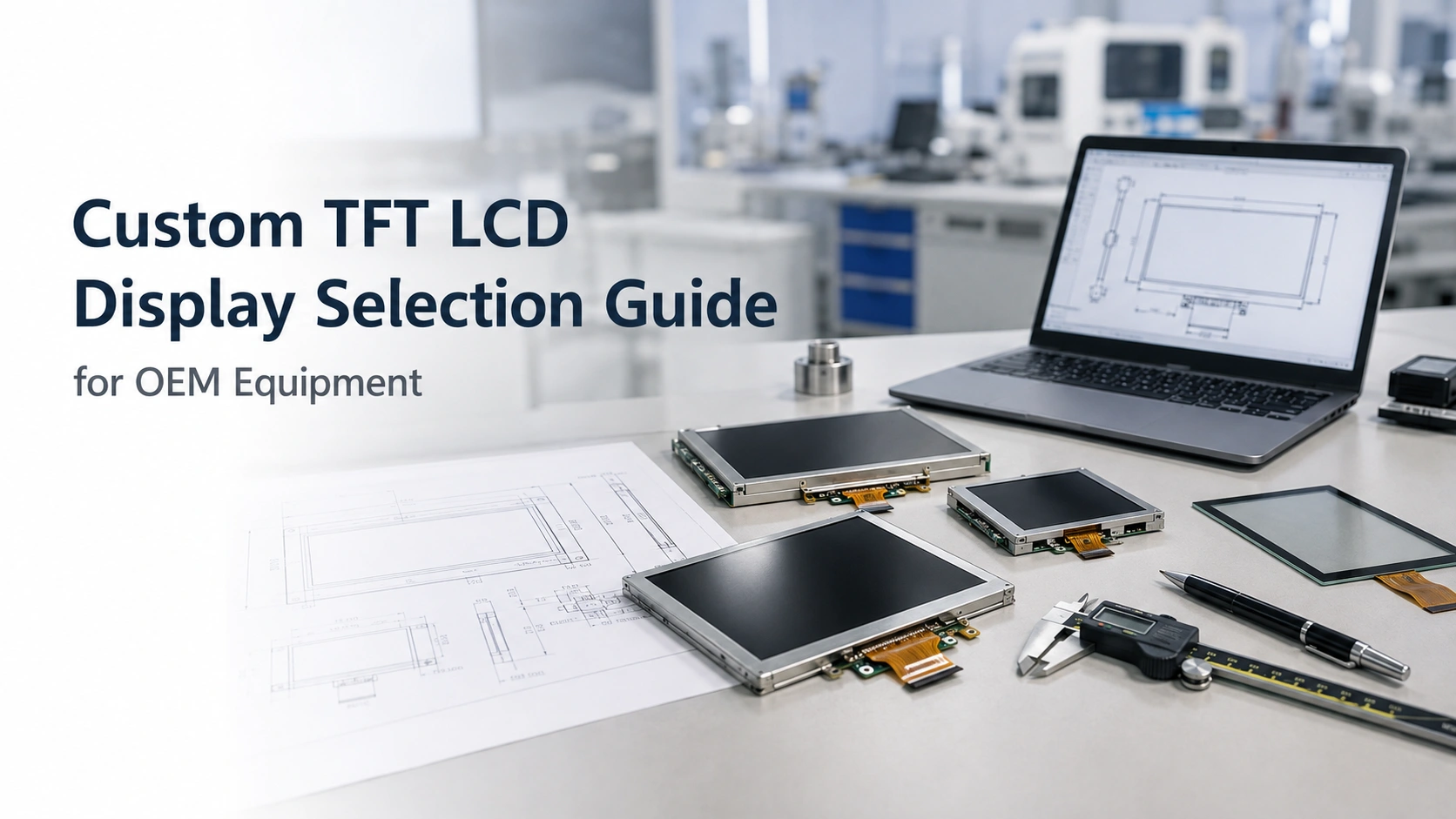
Define the Equipment Requirements First
The best starting point is the equipment design, not a supplier catalog. Document the space available for the display, the viewing direction, the operating environment, and the expected user interaction.
Key mechanical information includes:
- Overall outline dimensions
- Active viewing area
- Mounting-hole positions
- Module thickness
- Bezel or cover requirements
- Cable exit position
- Connector location
- Clearance behind the panel
A module that fits the visible opening may still create integration problems if its FPC, connector, PCB, or mounting points conflict with the enclosure. For this reason, a drawing or three-dimensional mechanical reference is more useful than a product name alone.
Environmental conditions should also be defined early. Outdoor or high-ambient applications may require higher brightness, a suitable operating-temperature range, and improved readability under changing light. Equipment used in dusty, humid, or vibration-prone environments may need a protective cover, gasket, strengthened mounting method, or carefully controlled cable routing.
The required duty cycle matters as well. A display used continuously may require different validation and spare-planning considerations from one used intermittently. These requirements should be written into the RFQ so that suppliers evaluate the same application conditions.
Select the Display Around Four Technical Interfaces
A TFT LCD module must match the equipment through mechanical, optical, electrical, and human interfaces. Reviewing these four areas together reduces the risk of late redesign.
Mechanical Interface
Confirm the outline size, active area, thickness, fixing method, and connector orientation. Do not assume that two modules with the same diagonal size are interchangeable. Their aspect ratio, mounting structure, cable length, and rear clearance may differ.
If the standard module cannot fit, ask whether the supplier can adjust the cable position, connector arrangement, PCB shape, or mounting accessories. Miqidisplay identifies these as available customization areas through its custom display solutions. Any proposed change should be confirmed with a drawing before mass production.
Optical Interface
Resolution should be selected according to the information that users must read, the viewing distance, and the available processing resources. Higher resolution can improve detail, but it may also affect interface bandwidth, software preparation, and system validation.
Brightness, contrast, viewing angle, color performance, and surface treatment should be evaluated under the actual lighting conditions of the equipment. A specification that appears adequate in a laboratory may not perform the same way behind a cover glass or in direct ambient light.
For sample approval, define measurable acceptance conditions. These may include visible defects, brightness consistency, color appearance, viewing-angle behavior, and readability at the intended operating distance. The engineering team should record the approved sample configuration so that later substitutions can be compared against the same baseline.
Electrical Interface
The display interface must match the host electronics and software architecture. Confirm the interface type, pin assignment, voltage requirements, timing, initialization sequence, and cable length. Common interface options vary by project, so the buyer should not select one based only on familiarity.
If the equipment uses an existing controller, request a compatibility review using the controller model, interface documentation, and current display pinout. If a new controller is possible, compare the system-level effort of using a standard module with the engineering cost of a customized interface.
Miqidisplay lists HDMI, USB, SPI, and VGA among its interface customization options. Buyers can also review a relevant HDMI TFT display category when a controller-based architecture is appropriate. The final interface must still be verified against the complete electrical specification.
Touch and User Interaction
If operators interact directly with the screen, define the touch technology, cover-glass shape, thickness, surface treatment, and expected input method. Capacitive and resistive touch solutions can produce different results depending on gloves, tools, cleaning procedures, and the surrounding mechanical design.
Touch integration also affects the stack height and optical path. The panel, adhesive layers, cover glass, and frame must be considered together. Ask for mechanical drawings and sample assemblies rather than evaluating touch response separately from the enclosure.
Compare Suppliers by Project Control
A capable OEM TFT LCD supplier should provide more than a list of available sizes. The supplier evaluation should focus on how clearly the project can be defined, verified, and controlled.
First, review the documentation. Useful materials may include dimensional drawings, interface specifications, pin definitions, optical data, operating conditions, sample records, and revision information. Missing or inconsistent documents increase integration risk, especially when several teams are involved.
Second, examine configuration control. The quotation should identify the exact module version, interface, cable, touch option, cover, and accessory configuration. Any approved change should be documented and reviewed before implementation. Substitution without written approval can create compatibility, appearance, or software problems.
Third, assess quality evidence. Ask how incoming materials, assembly stages, finished modules, and pre-shipment inspections are managed. Acceptance criteria should be clear enough for both the buyer and supplier to interpret consistently.
Fourth, evaluate communication and support boundaries. Engineering needs timely answers to technical questions, while procurement needs stable commercial documentation and revision tracking. Operations may need information about packing, labeling, spare quantities, and delivery coordination. These requirements should be included before the purchase order is released.
Miqidisplay presents itself as a display component supplier with custom R&D, multi-stage inspection, and technical support capabilities. Buyers should still confirm which services, documents, and inspection records apply to the specific project rather than treating general capability statements as contractual commitments.
Prepare a Complete RFQ or Fit-Check Package
A detailed request helps a TFT LCD module supplier recommend a realistic configuration and identify risks earlier. The RFQ should include:
- Target diagonal size, outline dimensions, and active area
- Required resolution, brightness, viewing direction, and surface treatment
- Interface type, voltage, timing, connector, cable length, and pinout
- Touch requirement, cover-glass design, and mechanical stack height
- Operating temperature, ambient-light conditions, vibration, humidity, and duty cycle
- Enclosure drawing, mounting constraints, and cable-exit requirements
- Prototype quantity, expected production quantity, target market, and schedule
- Inspection criteria, packaging needs, labeling, spare expectations, and revision control
Cost should be assessed at system level. A lower unit price may not remain economical if it requires enclosure changes, a new controller, additional software work, or repeated sample iterations. Buyers should also consider spare availability, configuration stability, inspection effort, shipping uncertainty, and the cost of qualifying a replacement module.
Warranty terms, compliance documents, and delivery timing should be confirmed in writing for the selected configuration. They should not be assumed from a general product page.
Work Through Sample Approval Before Production
Sample approval should verify both component performance and integration behavior. Install the sample in the intended enclosure and test the actual cable path, mounting pressure, viewing angle, brightness setting, touch response, and startup behavior.
Record the approved model, revision, drawings, interface, accessories, and visible appearance. If the design changes after approval, repeat the relevant checks. This process helps prevent a standard substitute from entering production without engineering review.
For an example of a current module format, buyers may examine the 3.5-inch IPS TFT LCD display, while treating its published configuration as a reference rather than assuming it matches a particular OEM design.
Conclusion
Selecting a custom TFT LCD display is a cross-functional decision involving mechanical fit, optical performance, electrical compatibility, touch integration, documentation, and long-term sourcing. The most reliable process begins with a complete equipment specification, continues through documented sample approval, and ends with clear configuration control.
A supplier should be evaluated on its ability to understand the application and manage the selected component—not only on catalog breadth or quoted unit price.
FAQs
What information should be sent when requesting a custom TFT LCD display?
Provide the required size, active area, resolution, interface, brightness, touch requirement, outline drawing, operating environment, quantity, and integration constraints.
Can a standard TFT LCD module be customized for OEM equipment?
Depending on the project, customization may be possible for cables, connectors, PCB layout, touch components, cover glass, mounting parts, backlight characteristics, or interface configuration.
How can an OEM TFT LCD supplier reduce integration risk?
The supplier should provide consistent drawings, pin definitions, sample documentation, revision control, inspection information, and technical answers for the stated application.
What should be checked during display sample approval?
Check mechanical fit, cable routing, startup behavior, optical appearance, readability, touch response, mounting pressure, and compatibility with the target electronics.
How should buyers compare a TFT LCD module supplier?
Compare documentation quality, configuration control, sample support, quality procedures, communication, packaging requirements, spare planning, and the supplier’s ability to address the application constraints.
To request a Miqidisplay technical fit review, send the display size, outline or enclosure drawing, active area, resolution, interface, touch requirement, brightness, operating conditions, quantity, and target application. This information helps the technical team assess compatibility, customization scope, sample requirements, and documentation needs.
Email: mary@miqidisplay.com
WhatsApp: +86 189 6801 5464; +44 07892800850