





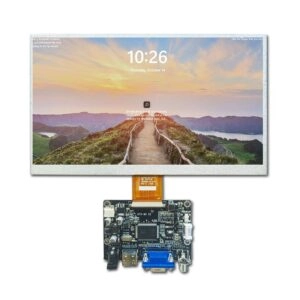
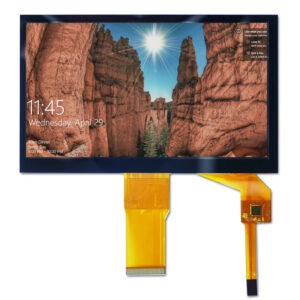




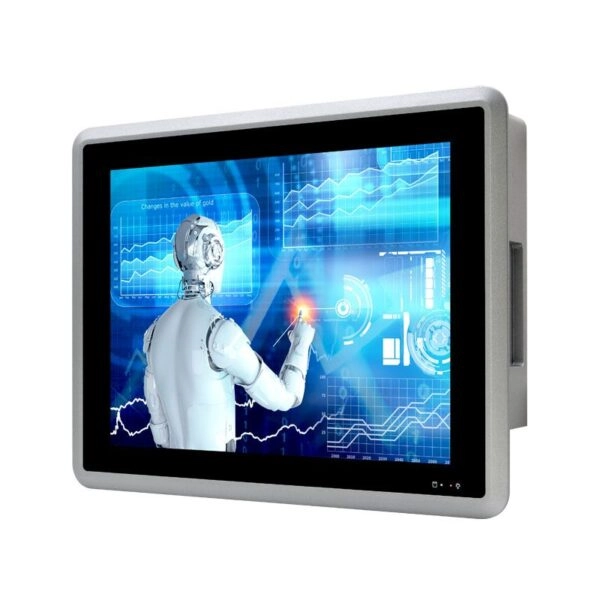
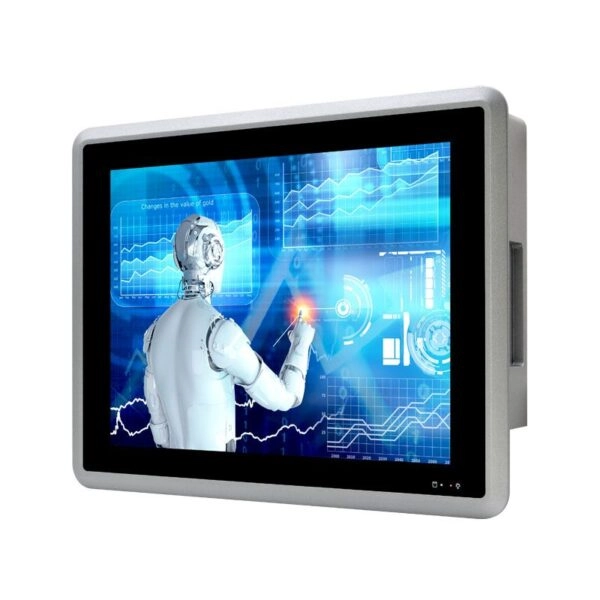
Industrial panel PCs are key components in manufacturing, automation, healthcare, transport, and many more areas, as they are all-in-one solutions for an effective Human-Machine Interface (HMI) in industrial environments. A panel PC consists of a rugged display and a powerful computing system. When choosing an industrial panel PC, several criteria need to be carefully considered in order to run the appropriate applications without any problems in the long term, with a minimum of down time and optimal integration.
1. Environmental Conditions and Durability Requirements
Industrial panel PCs are designed to be used in a variety of environments. The specific environment in which the panel will be deployed is often the determining factor as to whether a standard industrial panel PC or a more specialized unit will be required. For example, facilities with extreme temperatures, high levels of dust and/or moisture, high levels of vibration, and/or high levels of electromagnetic interference require a panel with a specific design to withstand these conditions.
Support of a wide operating temperature is a core requirement for many applications. In addition to typical office environments, many panel PCs for industrial applications are designed for operation in factories, in outdoor applications like kiosks, or in cold storage rooms. For applications which are exposed to high humidity and aggresive corrosion, components can be coated with conformal coatings. For dusty environments, fanless solutions are available, which do not have any moving parts which could break.
IP Ratings and Protection Against Dust and Water
IP ratings indicate protection levels against solids and liquids. Front bezels with IP65 or higher ratings resist dust ingress and water jets, essential for washdown environments in food processing or pharmaceutical manufacturing. EMI resistance further ensures stable operation near heavy machinery or high-voltage equipment.
Vibration, Shock, and Custom Enclosure Options
Vibration and shock resistance, often measured by IEC standards, becomes vital for mobile applications in vehicles or material handling equipment. Manufacturers offering custom enclosure options can tailor these protections to specific site conditions.
2. Display Size, Resolution, and Visibility
The size of the screen and the quality of the displayed images have a huge impact on the efficiency and usability of a system for operators. Standard sizes for monitor systems are between 7-inch compact monitor for very small control panels up to 21.5-inch and even bigger for complex SCADA applications.
Our products can be set to various resolutions such as Full HD (1920×1080) for best visual quality as well as other legacy resolutions to be able to run on existing software. We support various aspect ratios including 16:9 for modern applications as well as 4:3 for industrial HMIs that require a different display.
High-Brightness Displays and Outdoor Readability
High-brightness displays (1000 nits and up) are readable in very bright environments, like a factory floor during the day, or in direct sunlight. Anti-glare displays, with wide viewing angles, allow for viewing from many angles.
Optical Bonding and Special Form Factors
Optical bonding of the display to the touchscreen eliminates reflections and makes the display more durable by removing air from between the display surface and the touchscreen surface where moisture and dust could collect.
The new range of displays includes Round LCD displays and other special form factors, making it possible to develop equipment to exactly the specification required.
3. Touchscreen Technology Selection
In selecting a touch interface for industrial environments, the issue of interaction reliability must be taken into account. The Capacitive touchscreens are ideal for very clean environments and for applications where high levels of usability are desired as they provide smooth multi-touch gestural interaction with durable glass surfaces. Some versions of Projected capacitive touchscreens are also glove usable.
Our resistive touchscreens are designed to recognize any amount of pressure from any object, such as a stylus or even gloved hands and perform in high-contamination environments. These screens are not as clear and do not last as long as capacitive touchscreens.
Glass Panels, Coatings, and Touch Accuracy
Touch Panels can be integrated with Glass Panels to allow Glass thicknesses, Anti-microbial coatings for medical touch points, and other surface treatments to meet the plant’s operational needs. Touch response time and accuracy continue to be critical for all real-time control applications.
4. Processing Power and Performance Specifications
Workload dictates computational requirements. In general terms, a efficient Celeron processor will be sufficient to meet requirements for a typical HMI based application, whereas SCADA, Vision and Edge AI type of processing would typically require more powerful Intel Core i5 class processor or equivalent.
Memory, Storage, and Fanless Design
Memory / Storage: Amount of memory and range of storage options (e.g. capacity of SSD) that support fast multitasking and data logging. Reliable fanless design: No dust is accumulating on heatsinks and ensures reliability.
Graphics and Long-Term Component Availability
The graphics section handles high-resolution screens as well as multiple monitors and video connections. Components are available for the long term, so even medium to long production runs are no problem.
5. Connectivity and I/O Options
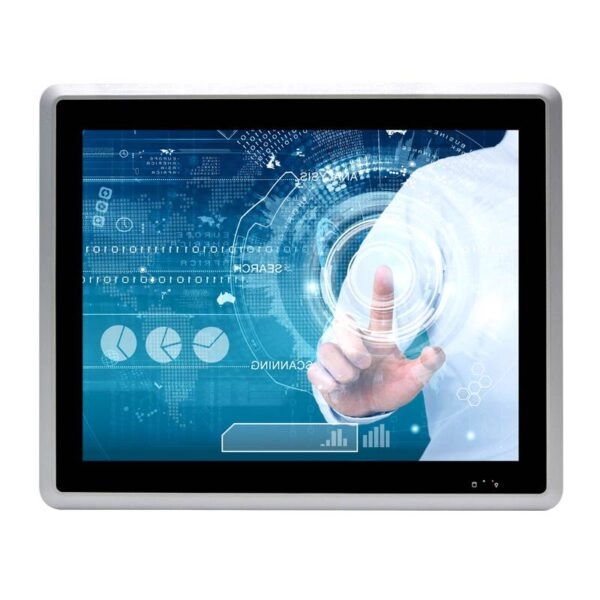
With robust I/O capability, our products can integrate into your existing industrial infrastructure. Standard I/O ports for the products are: Multiple USB ports, one or more Ethernet ports with support for PoE (in some models), HDMI, and serial COM ports for connection to old equipment.
The GPIO interfaces allow for direct control of sensors and actors. The wireless interfaces for Wi-Fi and Bluetooth allow for a mobile use or integration into the Internet of Things. The expansion slots and the modular design of the control units allow for later extensions without having to replace the complete system.
Custom Cable, Connector, and Interface Options
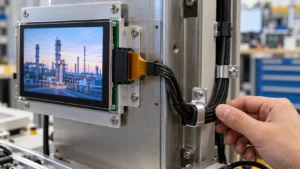
Cable lengths, connectors (e.g. M12 connectors for industrial applications) as well as interface boards can be configured to a specific application and integrated into control cabinets or machines.
6. Mounting and Installation Flexibility
The physical constraints of the installation guide the choice of a suitable enclosure and mounting. A panel mount design allows for a flush mounting in a control cabinet, an open frame design is suitable for a custom made enclosure. The monitors can be mounted using a VESA mount and then attached to an arm or wall.
These Compact all-in-one solutions reduce cabling and speed up installation. The slim designs of our enclosures enable installation in very narrow rooms. All mounting brackets, gaskets and bezels can be customized to match the corresponding application.
7. Longevity, Support, and Total Cost of Ownership
For industrial applications we encounter systems that are used over a time frame of 5 years and more. This also applies for warranties and roadmaps. Therefore components must have a sufficient lifetime and all measures must be taken to avoid any kind of obsolescence which necessitates changes on system level.
We work with reliable suppliers who keep an component stock and also are able to fulfill any required changes for a project that is in development. The quality of our suppliers is tested by a comprehensive test plan as well as by international certifications (ISO, CE, RoHS).
By making your building more energy efficient you save money in the long run as well as easily maintain your building. Many components in a modular building are easily accessible for quick repair, minimizing time lost due to maintenance.
FAQ
How long does an industrial panel PC last?
High-quality industrial panel PCs are designed to provide long life in harsh environments and can last 5–7 years or more, provided they have been specified correctly for the application.
What is the significance of the IP ratings when selecting an industrial panel PC?
Higher IP ratings provide better protection against dust and water. The front bezel of an IP65 panel PC is suitable for most factory environments, however a full system IP rating may be required in extreme circumstances.
Can industrial panel PCs be customized for specific applications?
Yes, leading display manufacturers offer an extensive range of options such as screen size, touch, connectors, brightness, and housing modification.
What types of processors are available for industrial panel PCs?
Industrial panel PCs are available with a variety of processors to meet the needs of the user. For simple HMIs there are energy efficient low power processors and for more demanding applications higher performance processors from Intel.
Are fanless designs recommended for industrial use?
No, fanless designs are not recommended for industrial use. However most industrial panel PCs are designed with fanless architectures to improve reliability in dirty or vibration prone environments.
Partner with a Trusted Industrial Display Manufacturer and Supplier
Business seeking reliable industrial panel PCs benefit from working directly with experienced suppliers capable of delivering both standard and fully customized solutions. Miqidisplay operates as a specialized display manufacturer with extensive expertise in TFT LCD, industrial monitors, and rugged X86 industrial panel PCs. The company provides comprehensive custom solutions including touchscreen integration, interface customization, high-brightness panels, and specialized form factors for diverse industrial applications.
Procurement specialists can explore the full range of TFT LCD displays, industrial monitors, and panel PCs through direct engagement to identify optimal configurations for specific project requirements. Contact the Miqidisplay team to discuss custom development needs and secure long-term supply partnerships for industrial display solutions.