


In industrial electronics and embedded system design, the display panel works as more than only a visual output component. It acts as the direct connection between equipment and operators. This connection strongly affects usability, safety, and long-term product stability. For manufacturers and procurement teams, one frequent technical decision involves choosing between Twisted Nematic (TN) and In-Plane Switching (IPS) display technologies.
This selection influences viewing quality, touchscreen compatibility, operating performance, and future maintenance expenses. TN technology still provides advantages in projects that mainly focus on lower cost. However, IPS displays now dominate industrial control systems, medical devices, smart terminals, and modern HMI equipment. Their popularity comes from stable optical performance and a better user experience.
The Engineering Core: How TN and IPS Pixel Structures Differ
Both TN and IPS belong to the TFT-LCD family. Still, their liquid crystal alignment methods are very different. These structural differences directly affect viewing angles, contrast, brightness uniformity, and color stability.
Twisted Nematic (TN): Vertical Crystal Alignment
TN technology is one of the earliest LCD technologies produced on a large scale. It remains widely used because the manufacturing process is mature and the production cost stays lower.
In a TN display, liquid crystal molecules form a twisted arrangement between two glass substrates. Under a normal condition, polarized light rotates through the twisted crystals. After that, the light passes through the display and creates visible pixels.
When voltage is applied, the molecules align vertically. This reduces light transmission and creates darker pixels.
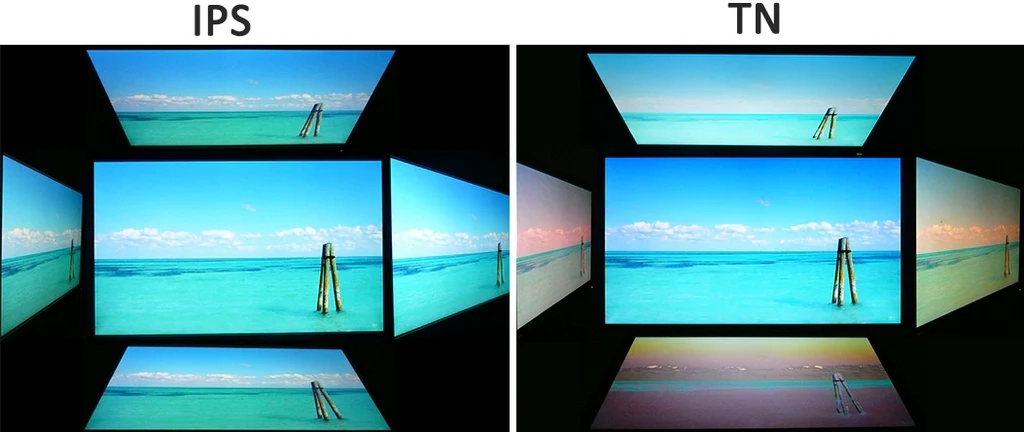
The limitation of this structure appears when the screen is viewed from side angles. Since the crystals align vertically, light transmission changes depending on the viewing position. As a result, contrast becomes uneven and noticeable color shifting appears.
Because of this, TN panels usually provide narrower viewing angles. They may also create image distortion when viewed from above or below.
In-Plane Switching (IPS): Horizontal Molecular Rotation
Engineers developed IPS technology to solve the optical weaknesses found in TN panels.
In IPS displays, liquid crystal molecules remain parallel to the display surface. When voltage is applied, the crystals rotate horizontally within the same plane. They do not tilt vertically.
This design keeps light transmission much more stable from different directions. Because the crystals stay parallel to the screen surface, image quality remains consistent even at wide viewing angles.
The result includes:
· Wider viewing angles
· Better color consistency
· Improved contrast stability
· Reduced color inversion
· Better touch interaction performance
These features explain why IPS technology is now widely applied in industrial touchscreens, medical displays, portable devices, and advanced HMI systems.
Performance Deep Dive: Critical Industrial Display Factors
Choosing an industrial display requires more than reviewing specification sheets. Real operating environments often expose weaknesses that normal specifications cannot fully show.
Viewing Angles and Gray Scale Inversion
Viewing angle remains the biggest difference between TN and IPS technology.
Standard TN displays normally support limited horizontal and vertical viewing ranges. In industrial workplaces, this can create problems when operators stand at different heights. Similar issues appear when workers approach machines from multiple directions.
The Gray Scale Inversion Problem
One major weakness of TN panels is gray scale inversion.
When the display is viewed from an incorrect vertical angle, dark areas may appear bright. Bright sections can become darker. Colors may also reverse or fade heavily.
In industrial applications, this may create operational risks. A warning signal, alarm icon, or color-based status indicator can become difficult to recognize from certain positions.
This issue becomes especially important in:
· Medical monitoring systems
· Industrial automation interfaces
· CNC machinery
· Smart manufacturing dashboards
· Vehicle control terminals
IPS displays remove most of these problems. They maintain stable image quality from nearly every viewing direction.
For industrial designers, IPS technology also gives greater mounting flexibility. The display performs effectively in both portrait and landscape layouts.
Color Accuracy and Contrast Performance
Color consistency has become more important in modern industrial systems.
TN displays usually provide lower contrast. Vertically aligned liquid crystals allow more unwanted light leakage. This reduces black depth and weakens image clarity.
Color generation is also more restricted. Many TN panels use 6-bit color depth. They apply dithering techniques to imitate additional colors.
IPS displays provide:
· Higher native contrast
· Better black levels
· More accurate color reproduction
· Wider color gamut support
· Improved graphical detail visibility
These advantages are valuable in applications such as:
· Diagnostic equipment
· Industrial visualization systems
· Transportation displays
· AI-enabled monitoring interfaces
· Smart retail terminals
Modern industrial HMIs often include detailed graphics, status indicators, and layered UI structures. IPS technology keeps visual clarity stable under different operating conditions.
Response Time: TN’s Traditional Advantage
Previously, TN displays achieved faster response times. Vertically moving liquid crystals switch more quickly than horizontally rotating IPS crystals.
For many years, TN panels stayed ahead in applications requiring extremely fast motion performance.
However, modern IPS technology has improved switching speed greatly. Current industrial IPS displays now offer response times suitable for nearly all industrial and commercial environments.
If a system does not involve highly specialized motion tracking or gaming-level refresh demands, IPS response times are fully acceptable for industrial control applications.
Power Efficiency Considerations
Power consumption remains an important factor in portable and battery-operated equipment.
TN displays usually achieve higher light transmission. Because of this, they require less backlight power to produce suitable brightness.
This makes TN technology useful in:
· Battery-powered instrumentation
· Simple handheld devices
· Outdoor low-power systems
· Entry-level embedded terminals
IPS displays normally require stronger backlighting because their electrode structure is more complex. Still, improvements in LED backlight efficiency continue to reduce this gap.
In many industrial systems, the improved usability and readability of IPS panels outweigh the slight increase in power consumption.
Touchscreen Integration: Why IPS Performs Better
Touch operation has become standard in modern industrial equipment.
One weakness of TN displays is their sensitivity to physical pressure. Pressing the screen can temporarily disturb the liquid crystal structure. This creates visible ripple or pooling effects.
IPS displays offer a much more stable structure. The liquid crystals remain aligned horizontally.
This makes IPS technology highly compatible with:
· PCAP touchscreens
· Industrial touch monitors
· Medical touch interfaces
· Self-service kiosks
· Smart control panels
As touchscreen adoption increases across industrial sectors, IPS panels continue becoming the preferred display foundation.
When to Choose TN Displays
Although IPS technology keeps expanding, TN displays still match several industrial applications.
Budget-Sensitive High-Volume Manufacturing
In products where reducing BOM cost is critical, TN displays provide an economical solution.
Examples include:
· Basic industrial controllers
· Simple measuring instruments
· Entry-level appliances
· Fixed-position operator terminals
Fixed Viewing Applications
When users always face the display directly, TN viewing limitations become less important.
Common examples include:
· ATM interfaces
· Treadmill consoles
· Fixed machinery panels
· Simple embedded systems
Low-Power Outdoor Equipment
TN panels require lower backlight intensity. Therefore, they can improve energy efficiency in portable outdoor devices.
When to Choose IPS Displays
IPS technology now leads modern industrial equipment because of its flexibility and dependable optical performance.
Industrial Handheld Devices
Portable equipment changes viewing angles during operation. IPS panels maintain readability regardless of device position.
Examples include:
· Industrial tablets
· Data collection terminals
· Portable diagnostic systems
· Logistics scanners
Advanced Industrial HMIs
Modern industrial interfaces depend heavily on graphical visualization, color coding, and touch interaction.
IPS displays improve usability in:
· Smart factory systems
· Automation dashboards
· Energy management terminals
· Industrial IoT equipment
Safety-Critical Interfaces
In environments where visibility directly affects operational safety, IPS displays reduce the risk of misreading alarms or indicators.
Industries include:
· Medical equipment
· Transportation systems
· Industrial automation
· Process control systems
FAQ
What is the main difference between TN and IPS displays?
The main difference involves the liquid crystal alignment method. TN displays use vertically aligned crystals. IPS displays rotate crystals horizontally. This structural difference influences viewing angles, color consistency, and contrast performance.
Are IPS displays better for industrial touchscreens?
Yes. IPS displays provide stronger structural stability and more consistent optical performance during touch interaction. This makes them more suitable for industrial touchscreen applications.
Why do IPS displays have wider viewing angles?
IPS liquid crystals rotate within the plane of the display instead of tilting vertically. This keeps light transmission more consistent from different viewing positions.
Which display technology is better for outdoor industrial equipment?
The answer depends on the specific application. TN may provide lower power consumption. IPS delivers better readability from different viewing angles. High-brightness IPS displays are now increasingly used in outdoor industrial environments.
Industrial Display Manufacturer & Supplier Support
As a professional TFT LCD display manufacturer and industrial display solution supplier, Miqidisplay provides customized display solutions for industrial automation, medical equipment, transportation systems, embedded electronics, and smart commercial devices. The company offers a wide portfolio that includes TFT LCD displays, IPS TFT panels, industrial touch monitors, sunlight-readable displays, wide-temperature LCD modules, and custom display integration services. With more than 20 years of industry experience, advanced manufacturing capability, and global customization support, Miqidisplay helps OEM manufacturers, system integrators, and equipment suppliers build reliable display solutions for demanding industrial applications.