






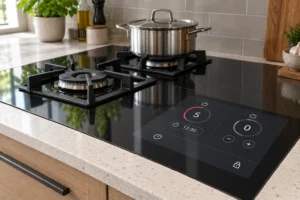
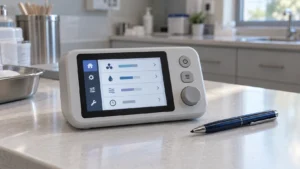

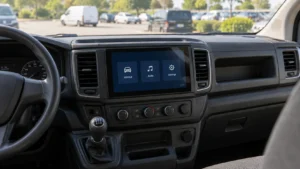

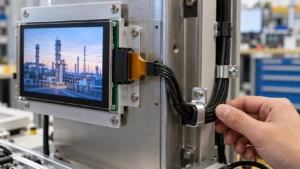
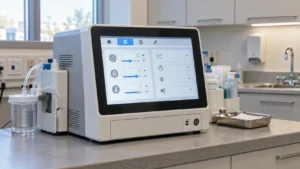

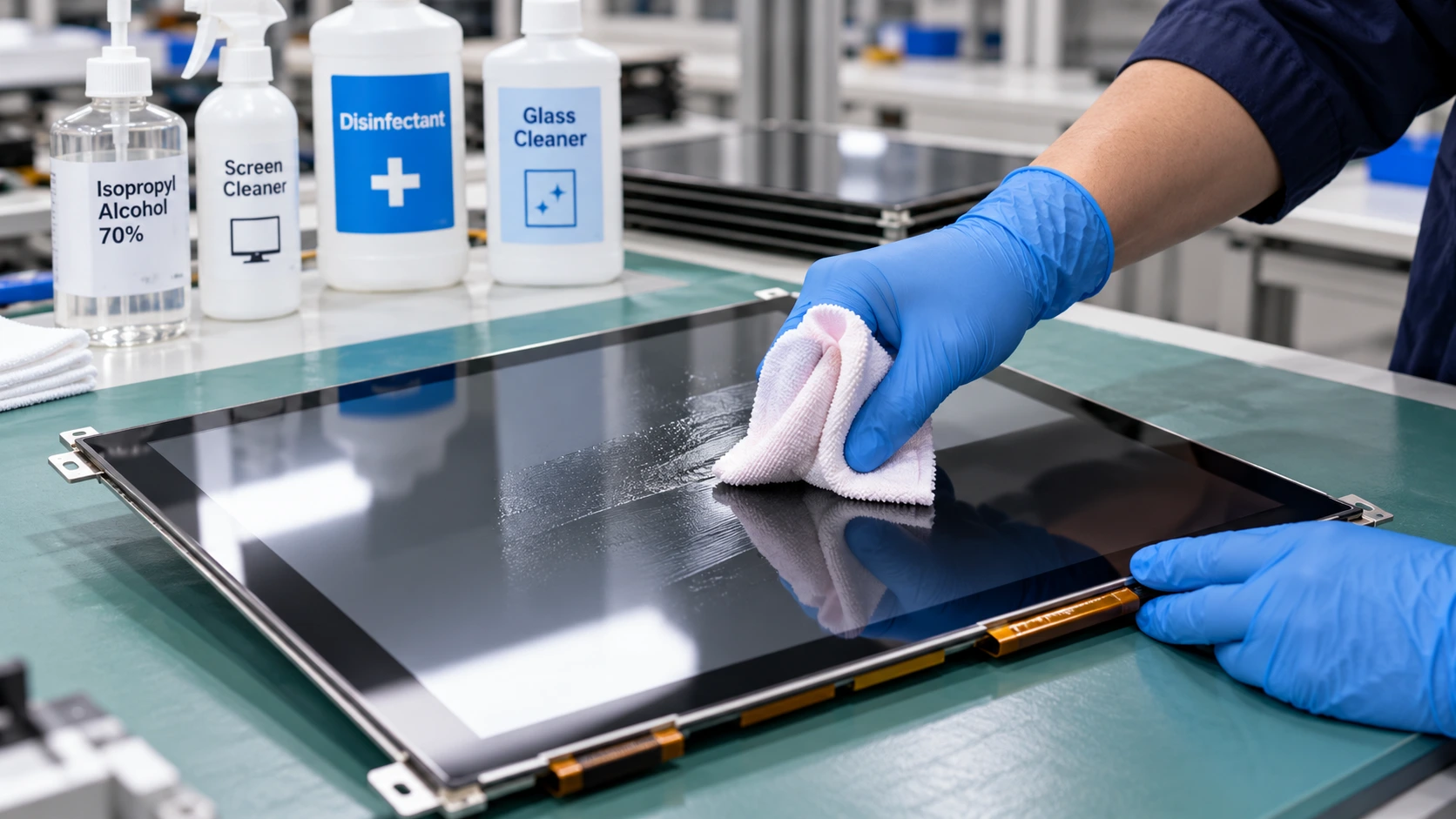
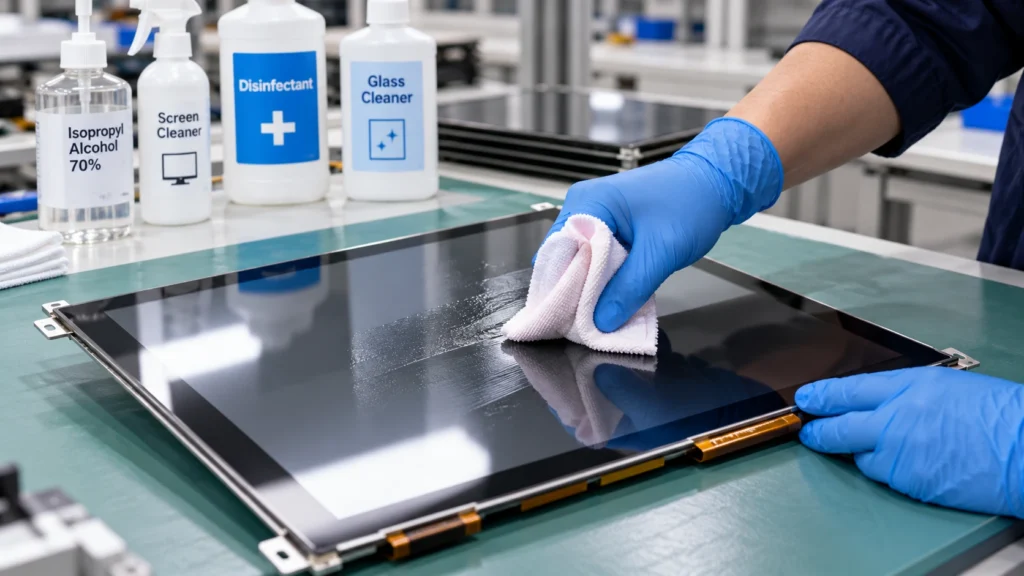
For an OEM or integration team, how cleaning chemicals influence capacitive touch cover materials is a cover-material specification, not a housekeeping detail. A capacitive touch module can register input while its cover surface, hard coat, printed border, adhesive edge, or oleophobic treatment is altered. The purchasing decision is to define chemical exposure, identify exposed layers, and approve the assembled module with evidence.
Why chemical compatibility belongs in the cover-material RFQ
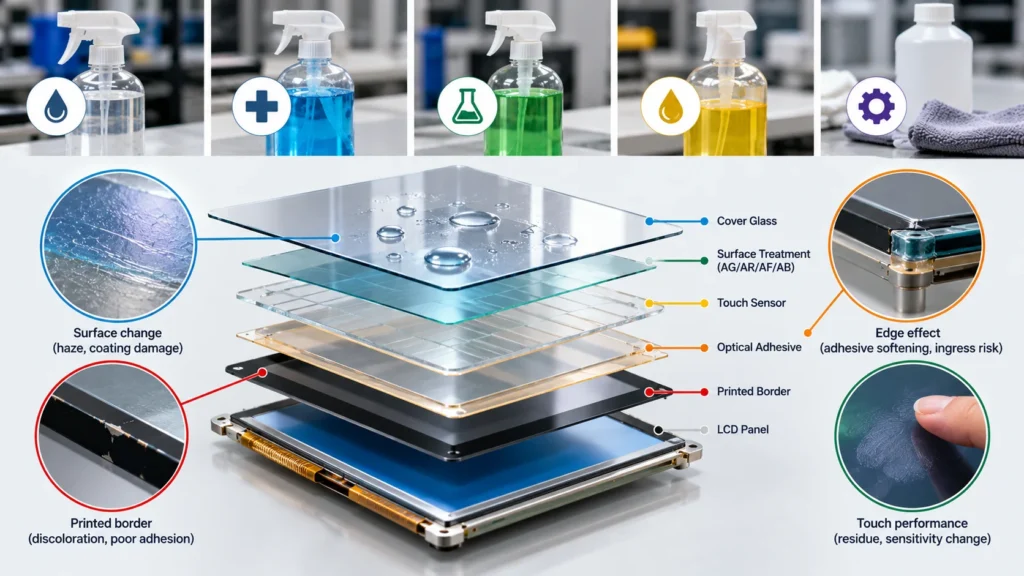
The cover is the first barrier between the operator and the projected-capacitive sensor. It may be glass or another transparent cover construction, with a hard coat, anti-glare (AG), anti-reflective (AR), anti-fingerprint (AF), or anti-bacterial (AB) treatment. Behind it are printed inks, optical adhesive, sensor electrodes, polarizers, seals, and the LCD module. A liquid that appears harmless on glass can still attack a coating, soften an adhesive edge, stain an ink border, or migrate into a gap.
The risk depends on concentration, temperature, contact time, wiping pressure, frequency, and drying method. Record the product name, dilution, dwell time, and whether the cloth is saturated. “Chemical-resistant” is incomplete until chemistry and pass/fail criteria are named.
Separate the visible face from the full module. A front-surface test may show no mark while an edge, gasket, adhesive fillet, or seal is affected. State whether the requirement covers the face, bezel area, edge seal, or complete stack.
How common chemical classes affect capacitive touch covers
Alcohols and water-based disinfectants
Diluted alcohol may be acceptable for some glass and coating systems, but concentration and repeated exposure matter. Higher concentrations can extract coating components, change surface feel, or leave a haze after many cycles. Water-based formulations can introduce surfactants, salts, or fragrances that dry into films. Specify the exact formulation and inspect gloss, haze, reflectance, fingerprint behavior, and touch response after exposure.
Ammonia, alkaline cleaners, and oxidizers
Ammonia and strongly alkaline cleaners can attack some surface treatments and printed materials. Oxidizing products, including bleach-based formulations, may discolor inks or alter a hard coat when the contact time is long. The correct procurement question is not whether a product is marketed as a glass cleaner; it is whether the complete cover construction has been tested against the intended concentration and cycle count.
Solvents, oils, and surfactant-rich formulations
Ketones, aromatic solvents, glycol ethers, and oil-bearing cleaners may swell or soften polymers used in coatings, seals, or adhesive edges. Surfactants can reduce water-break behavior and make fingerprints or streaks more visible. If the module uses a printed border, confirm that the ink remains adhered and that the cleaning fluid cannot wick through a cut-out or edge.
Abrasive or particulate products
Powders and textured wipes create a combined chemical-and-mechanical risk. Even a chemically compatible liquid can produce scratches when particles are dragged across the cover. The acceptance plan should therefore identify the cloth type, pressure, number of strokes, and lighting used for cosmetic inspection.
What changes first: surface, edge, or touch performance?
Chemical damage often appears first as an optical or cosmetic change: whitening, rainbowing, loss of gloss, increased haze, a visible wipe pattern, or a shift in reflectance. These changes can make a module difficult to read even when touch still works. A degraded AF layer may increase fingerprint retention; a textured AG surface may become uneven; an AR stack may show higher residual reflection.
The edge is a separate failure path. Repeated wetting can soften an adhesive fillet or expose a path into an air gap. Fluid reaching the sensor or polarizer may cause bubbles, delamination, dead zones, or unstable touch behavior. Do not infer edge compatibility from a face-only coupon.
Touch performance can move indirectly. Changed surface friction may alter finger coupling or glove interaction; edge swelling can stress the sensor; residue may create conductive paths or false touches. Approval should use the production-intent cover, sensor, adhesive, controller settings, and mounting structure.
Turn cleaning exposure into a measurable specification
Create a chemical matrix before requesting quotations. For each agent, list concentration, temperature, contact time, wipe cycles, drying interval, and exposed location. Define measurable limits, for example:
- No visible discoloration, cracking, lifting, or edge swelling under defined lighting.
- No unacceptable change in haze, gloss, reflectance, transmittance, or color.
- No loss of printed-border adhesion or legibility.
- No bubbles, delamination, or fluid ingress at edges and cut-outs.
- Touch activation and reported coordinates remain within the project limits.
- The sample remains cleanable without a progressive change over the agreed cycle count.
Ask the supplier to identify the test method, number of samples, conditioning time, inspection magnification, and whether results are typical or guaranteed. A pass statement without the formulation, cycle count, and stack-up is difficult to use for purchasing approval.
Specify the whole cover construction, not only “glass”
The material line in an RFQ should connect the cover to the optical and mechanical stack. Include the material, thickness and tolerance, strengthening or tempering process where applicable, edge finish, cut-outs, printed border, surface treatment, adhesive construction, and bonding method. If an AG, AR, AF, or AB treatment is requested, define its optical and durability targets separately. A coating label alone does not establish chemical resistance.
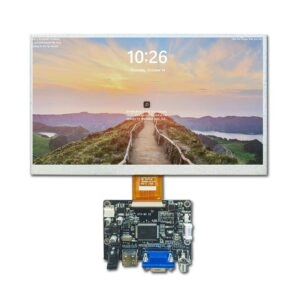
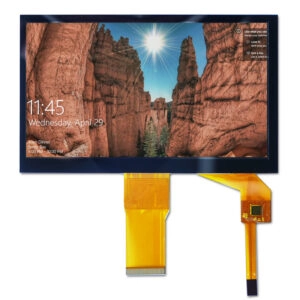
Miqidisplay’s capacitive touch screen modules include customizable cover-lens options such as AG, AR, AF, and AB treatments. One listed example is an 8-inch MIPI LCD module with in-cell capacitive touch, specified at 800 × 1280 resolution. Confirm the cover construction and chemical compatibility for the configuration selected for your project.
Validate an assembled sample before production approval
Start with a production-intent sample rather than a loose sheet. Clean the same active area, border, edge, and gasket that the buyer will receive. Use the defined cloth and chemical matrix, then inspect immediately and after a recovery interval. Measure appearance and touch before exposure and after the final cycle.
The sample plan should include bare-finger and applicable glove input, edge and corner inspection, visual checks under representative lighting, and a record of residue. If optically bonded, evaluate the bonded stack; if an air gap remains, inspect for fluid paths and trapped contamination.
For custom geometry, request a cross-sectional drawing and tolerance stack. Miqidisplay’s custom display solutions page describes custom-cut cover glass, touch-panel glass adjustments, and optical bonding to verify during engineering review. These options do not replace chemical testing.
Supplier questions that reduce batch risk
Before issuing a purchase order, ask:
- Which cover, coating, ink, adhesive, and edge-seal materials are in the proposed stack?
- Has the exact cleaning formulation been tested, and under what concentration, temperature, dwell time, and cycle count?
- What are the visual, optical, touch, and ingress acceptance limits?
- How are coating lot, ink lot, adhesive lot, and engineering changes recorded?
- Will the approved sample, drawing, and test record be the reference for repeat orders?
Keep answers with the drawing and sample-approval record. A coating-supplier or adhesive-grade change can invalidate earlier compatibility evidence even when cover dimensions are unchanged.
Conclusion
Cleaning chemicals influence capacitive touch covers through surface chemistry, optical treatments, printed borders, adhesive edges, and the assembled stack. Name the real exposure, specify the construction, test a production-intent sample, and retain measurable acceptance records. Compatibility should be confirmed against the exact configuration and test plan.
FAQs
Is glass automatically resistant to all cleaning chemicals?
No. The glass substrate may tolerate an agent while a coating, ink, adhesive, or edge seal does not. Approve the complete construction against the actual formulation.
Should a buyer specify a maximum alcohol percentage only?
No. Concentration is only one variable. Include contact time, temperature, wipe cycles, cloth, drying method, and the other ingredients in the formulation.
Can optical bonding solve chemical-compatibility problems?
No. Bonding can change interfaces and reduce an air gap, but it does not make every coating, adhesive, or edge seal compatible. The bonded assembly still needs testing.
What should be sent with an RFQ?
Send the display type, diagonal size, active area, outline drawing, resolution, interface, touch requirement, brightness, viewing direction, operating temperature, cleaning matrix, quantity, and integration constraints. Include the intended chemical product or safety-data information when available.
Request a Miqidisplay technical-fit review
For a capacitive touch display module with defined cleaning-chemical exposure, contact the Miqidisplay technical team. Share the display type, target size, active area, outline dimensions, resolution, interface, touch requirement, brightness, viewing direction, temperature range, mechanical constraints, quantity, drawings, cleaning agents, and integration environment. These inputs help assess component compatibility, customization scope, sample requirements, documentation, and repeat-order controls.
Email: mary@miqidisplay.com
WhatsApp: +86 189 6801 5464