





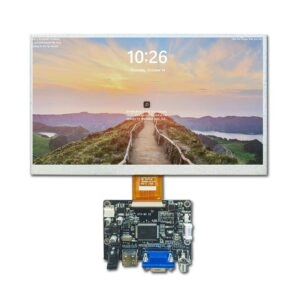
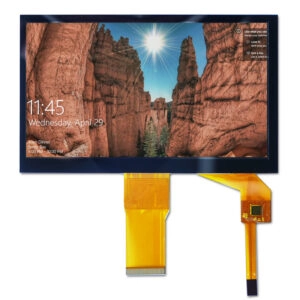


Pilot-build documentation for an OEM LCD module should prove that the module being assembled, tested, and approved is the same configuration intended for repeat production. A useful package does more than record whether pilot units worked. It establishes the controlled product baseline, build instructions, inspection evidence, deviations, and approval status that engineering, quality, procurement, and the supplier will use after the pilot run.
Without that shared baseline, a successful sample can still lead to inconsistent later batches. A revised flex cable, connector, optical stack, firmware setting, or inspection method may enter the build without every stakeholder understanding the effect. The pilot package therefore acts as both a technical record and a production-release gate.

What Pilot-Build Documentation Must Accomplish
The document set should answer five questions: What exactly was built? Which inputs and processes were used? How was conformity checked? What exceptions occurred? Which configuration was approved for the next stage? If a record cannot help answer one of these questions, it may be supporting information rather than a release-controlled document.
The package should also identify document owners, revision levels, approval dates, and the relationship between files. A drawing, specification, inspection plan, and approved sample must not describe different versions of the module. Establish one project identifier and one revision convention before the pilot build begins.
Freeze the Product Configuration Baseline
The controlled product specification is the starting point. It should identify the display type, diagonal size, active area, outline dimensions, resolution, interface, connector and pin assignment, viewing direction, brightness requirement, touch configuration if applicable, operating temperature, and other project-specific limits. A related datasheet reading guide can help teams separate typical values from limits that must be verified.
Attach or reference the mechanical drawing, electrical interface definition, cable or flex drawing, connector details, and optical stack information relevant to the approved configuration. Dimensions need datums, tolerances, and measurement references; a nominal outline alone is not enough for enclosure integration.
The supplier may retain detailed internal manufacturing records, but the OEM still needs controlled identifiers for critical components and subassemblies. The release package should state which substitutions require notice or requalification. This prevents a purchasing description such as “same size and resolution” from becoming the only configuration control.
Record How the Pilot Units Were Built
A pilot report should capture the build date, quantity started, quantity completed, lot or batch identifiers, and the revision of every released input. It should identify the assembly flow and the process checkpoints that can affect module fit, electrical behavior, optical appearance, or touch performance.
Work instructions should be specific enough for repeat execution. They may cover connector handling, cable routing, adhesive or bonding conditions, protective-film handling, fixture use, cleaning controls, and programming or configuration steps. Exact controls depend on the module design and integration environment, so they should be verified against the applicable product specification and supplier process.
Record actual process values where they matter instead of confirming only that an instruction was followed. When a parameter has an allowable range, the report should show the target, the permitted range, and the observed result or traceable data source.
Connect Inspection Evidence to Acceptance Criteria
Inspection records should map directly to the approved requirements. Mechanical dimensions, interface operation, current or power behavior, visual quality, brightness or uniformity where specified, touch response, and environmental checks should each have a defined method and disposition. The exact list depends on the application and module configuration.
Use the custom LCD module acceptance criteria as a separate control from the build instructions. Instructions define how to make the pilot units; acceptance criteria define how to judge them. For every inspection item, record the sample size, equipment or fixture identifier, method revision, result, inspector, and pass/fail decision.
Photographs can support appearance or assembly records, but they should not replace measurable criteria. When a visual limit is important, use approved boundary samples or clearly defined defect categories, viewing conditions, and inspection distance. Keep raw measurement data linked to the summary so a later reviewer can reconstruct the decision.
Control Deviations, Failures, and Open Actions
Pilot builds often reveal issues. The documentation should preserve them rather than presenting only a clean summary. Each nonconformance needs a unique identifier, affected quantity, description, containment action, technical assessment, and disposition. State whether the unit was reworked, accepted under concession, scrapped, or held for investigation.
A temporary deviation must include an expiration condition. It should not silently become the production standard. If the correction changes the drawing, specification, material, cable, connector, process, inspection method, or configuration setting, update the affected controlled documents and identify the new revision.
Maintain an action log with an owner, due date, verification evidence, and closure status. Separate issues that block release from improvements that can continue after release. This allows the production-readiness review to make a clear decision rather than relying on meeting notes or email history.
Build Traceability and Change Control Into the Package
Traceability should connect each pilot unit or lot to the applicable configuration and inspection evidence. The appropriate depth depends on risk, volume, and customer requirements, but the record may include date or lot codes, supplier batch identifiers, critical component revisions, and test records.
The package also needs a change-control rule for the period after approval. Define which changes require notification, documentation review, new samples, partial validation, or a new pilot build. Changes to mechanical fit, interface, optical performance, touch construction, operating range, or critical materials should not be treated as administrative updates.
Procurement should align purchase specifications and order descriptions with the same released revision. Quality agreements and change-notification responsibilities should identify who communicates a proposed change, what supporting evidence is required, and who authorizes implementation.
Use a Formal Production-Release Review
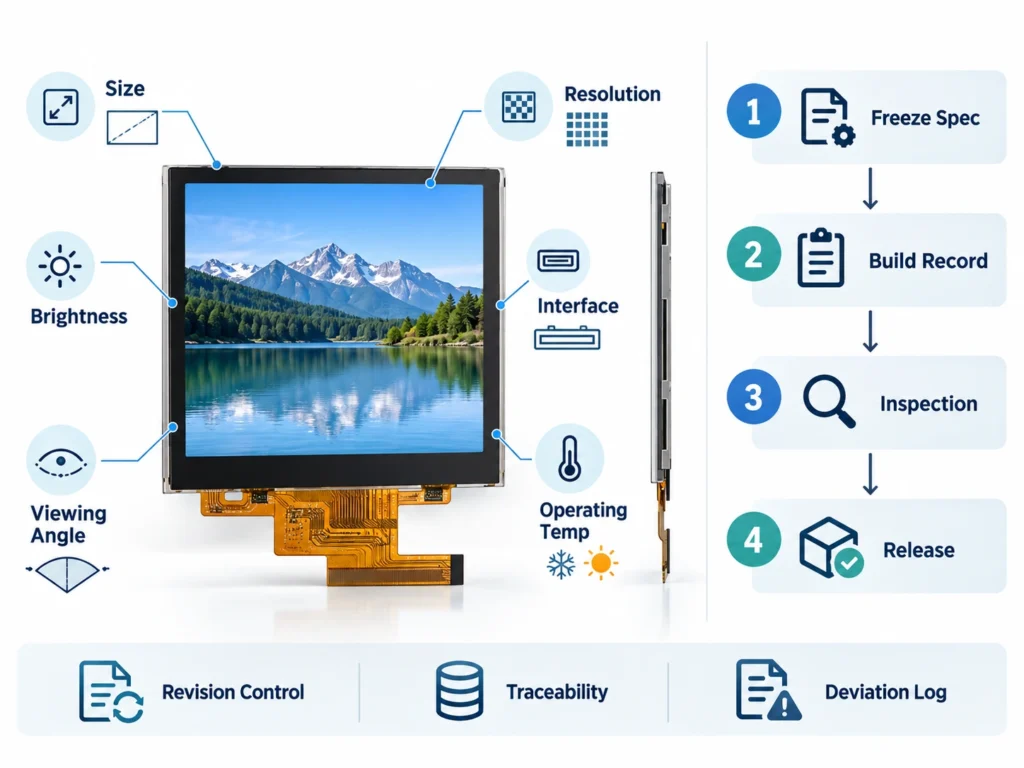
Before release, engineering, quality, procurement, and the supplier should review one indexed package rather than independent file collections. A practical release checklist includes:
- Product specification and drawings match the pilot configuration.
- Build records identify quantities, lots, revisions, and process checkpoints.
- Inspection results are complete and linked to approved criteria.
- Deviations have documented dispositions and blocking actions are closed.
- Traceability, packaging, labeling, and change-notification requirements are defined.
- Authorized reviewers sign the release decision and effective revision.
Supplier capability still matters. Use a structured LCD module supplier evaluation to confirm that documentation control, sample handling, inspection support, and change communication fit the project. When reviewing Miqidisplay’s TFT LCD display modules, compare the selected module’s specifications with the controlled requirements before freezing the pilot-build configuration. Miqidisplay also presents display-module customization options that can be reviewed against the released drawings and interface requirements; exact feasibility should be confirmed for the selected module.
Conclusion
Effective pilot-build documentation turns a limited run into a controlled production decision. The essential outcome is not a large file archive, but a coherent record showing the approved configuration, how it was built, how it was checked, what changed, and who released it. When every record points to the same revision, teams can assess later changes and batch consistency with far less ambiguity.
FAQs
Is an approved sample enough to release an OEM LCD module?
No. A sample shows a physical result, but it does not fully define the drawing revision, process conditions, inspection method, deviations, or change-control responsibilities needed for repeat production.
Who should approve the pilot documentation package?
Approval commonly involves OEM engineering, quality, and procurement plus the supplier’s responsible technical and quality representatives. The exact approval matrix should match project risk and contractual responsibilities.
Should every pilot-build issue block production release?
Not necessarily. Each issue should be classified by effect and risk. Release-blocking items require closure, while lower-risk improvements may remain open only with documented ownership, timing, and approval.
When is another pilot build required after a change?
A new pilot may be appropriate when a change affects fit, interface behavior, optical performance, touch construction, operating conditions, critical materials, or the validity of earlier tests. The decision should follow the agreed change-control plan.
Request a Miqidisplay Technical Fit Review
For an OEM sourcing assessment, contact the Miqidisplay technical team with the display type, diagonal size, outline dimensions, active area, resolution, interface, touch requirement, brightness, viewing direction, operating temperature, mechanical constraints, expected quantity, drawings, and integration environment. These inputs allow the team to assess component compatibility, possible customization scope, sample requirements, documentation needs, and batch-consistency controls before a quotation or production commitment is evaluated.
Email: mary@miqidisplay.com
WhatsApp: +86 189 6801 5464