









01 / Challenge
Challenge
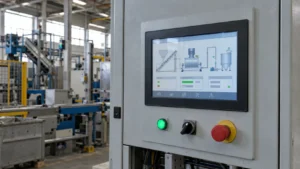
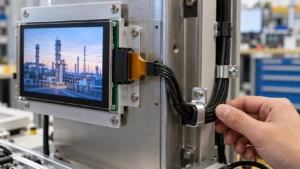
Industrial control interfaces need to present operating values, status information and alarms within a fixed equipment opening. Readability at different viewing positions, adaptation to equipment temperatures and compatibility with the host electronics must be considered together. This solution concept evaluates a 10.4-inch 4:3 display for an industrial machine control panel.
02 / Solution
Solution
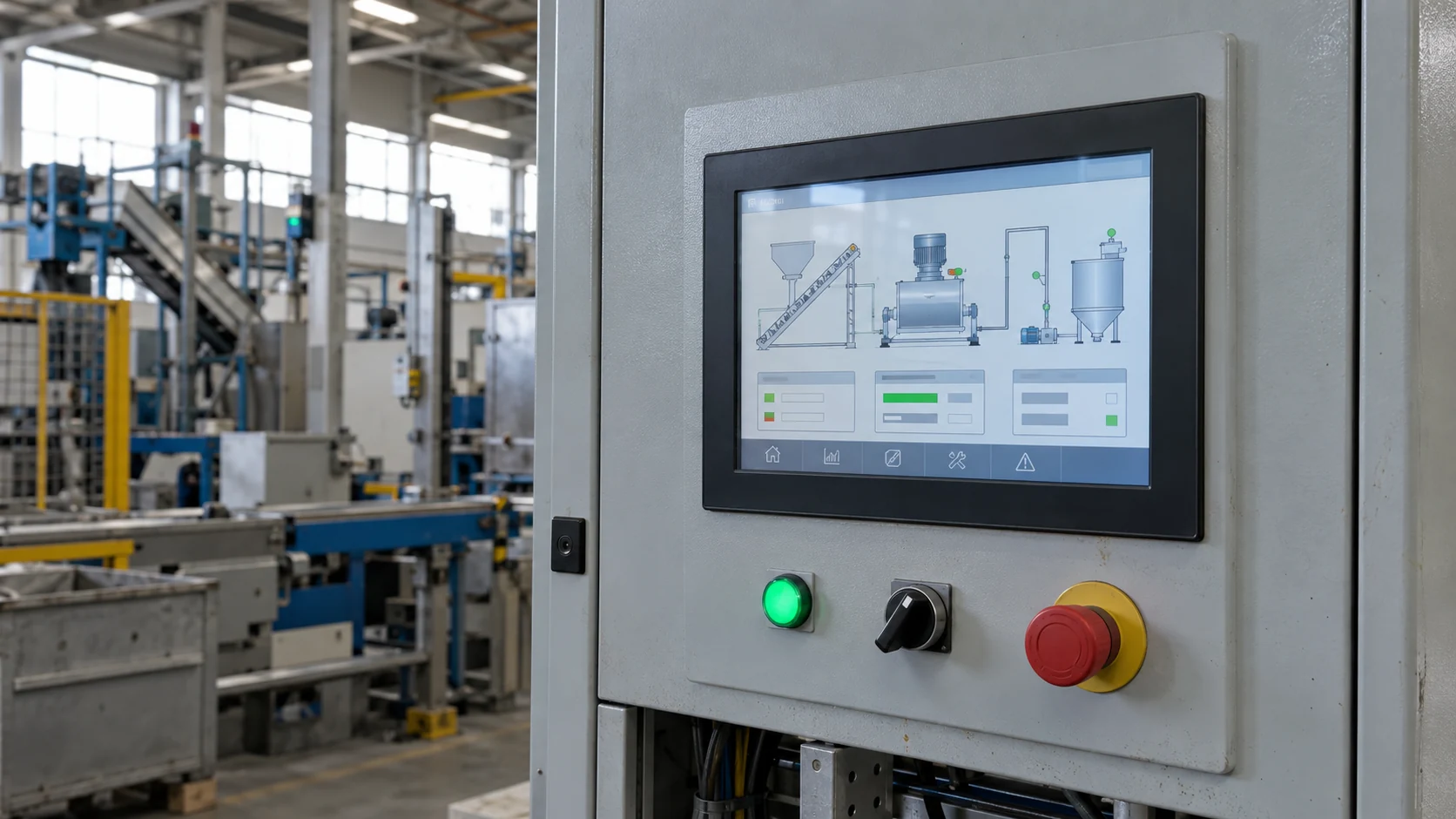
The proposed configuration is based on the ZC-104001-1001, a 10.4-inch transmissive TFT module with 1024 × 768 resolution and an LVDS interface. The design review brings optical specifications, mechanical fit and electrical integration into a single set of measurable requirements.
Readability for a 4:3 control interface
The drawing specifies an LCM interface luminance of 800 cd/m². The optical table lists a contrast ratio of 1200:1 typical and 1000:1 minimum, with typical viewing angles of 85° in each direction at CR ≥10. These values provide inputs for interface design and viewing-position evaluation. Final equipment readability also depends on cover materials, reflections, ambient light and the selected brightness setting.
Wide-temperature integration review
Both the specified operating and storage ranges are −30°C to +80°C. The reliability section defines high- and low-temperature operation and storage requirements, humidity exposure, thermal shock and ESD conditions. The equipment enclosure, heat paths and actual module temperature should be assessed during prototype evaluation. The listed reliability conditions are requirements rather than evidence of completed project tests.
Defined mechanical and LVDS integration
A nominal outline of 226 × 174.3 × 5.64 mm and a 211.2 × 158.4 mm active area define the module envelope and display opening. The specification includes a 50-pin connection definition, JD9168S driver and 8-bit RGB LVDS VESA input timing as the default format. Host mapping, timing, initialization and the complete power sequence require engineering review; sharing the same screen size does not establish replacement compatibility.
Technical specifications
| Item | Specification |
|---|---|
| Model | ZC-104001-1001; Rev. A; 2026-04-29 |
| Display size | 10.4 inch |
| Resolution | 1024 × RGB × 768 |
| Aspect ratio | 4:3 (calculated from resolution) |
| Interface | LVDS; 50-pin connection definition |
| Driver IC | JD9168S |
| Display mode | Transmissive TFT, normally black |
| Luminance | 800 cd/m²; drawing specification |
| Contrast | 1200:1 typical; 1000:1 minimum |
| Viewing angles | 85° U/D/L/R typical at CR ≥10 |
| NTSC ratio | 65% minimum |
| Outline | 226 (+0/−0.3) × 174.3 (+0/−0.3) × 5.64 ±0.2 mm |
| Active area | 211.2 × 158.4 mm |
| Pixel pitch | 0.20625 × 0.20625 mm |
| Digital supply | VDD 3.3 V typical; other rails also required |
| Operating temperature | −30°C to +80°C |
| Storage temperature | −30°C to +80°C |
| Touch | Not specified as part of this module |
Reliability requirements
| Item | Specification |
|---|---|
| High-temperature operation and storage | 80°C; 120 h each |
| Low-temperature operation and storage | −30°C; 120 h each |
| Humidity | 60°C; 90% RH; 120 h |
| Thermal shock | −30°C → 25°C → 80°C; 0.5 h → 5 min → 0.5 h; 10 cycles |
| ESD | Air ±8 kV; contact ±4 kV; 10 times each; 330 Ω; 150 pF |
These are specification requirements, not completed project test records. Final inspection after testing requires 24 hours at room temperature. The listed optical values do not establish identical performance across the entire temperature range.
03 / Result
Result
This configuration provides a defined starting point for industrial control panel development: a 4:3 XGA interface, an 800 cd/m² luminance specification and a wide-temperature module specification within a documented mechanical envelope. It gives the engineering team concrete inputs for prototype selection and system validation. Installed performance should be confirmed against the equipment’s actual operating conditions.
Discuss Your Industrial Display Requirements
Send your drawing, installation space, host interface and operating conditions to Miqidisplay for a display integration review.


