





01 / Challenge
Challenge
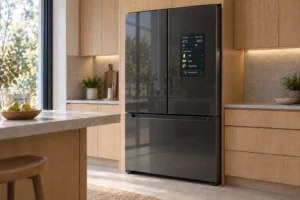
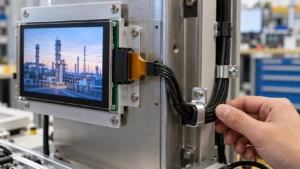
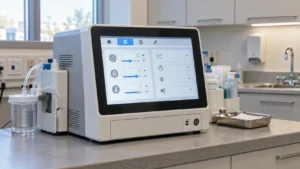
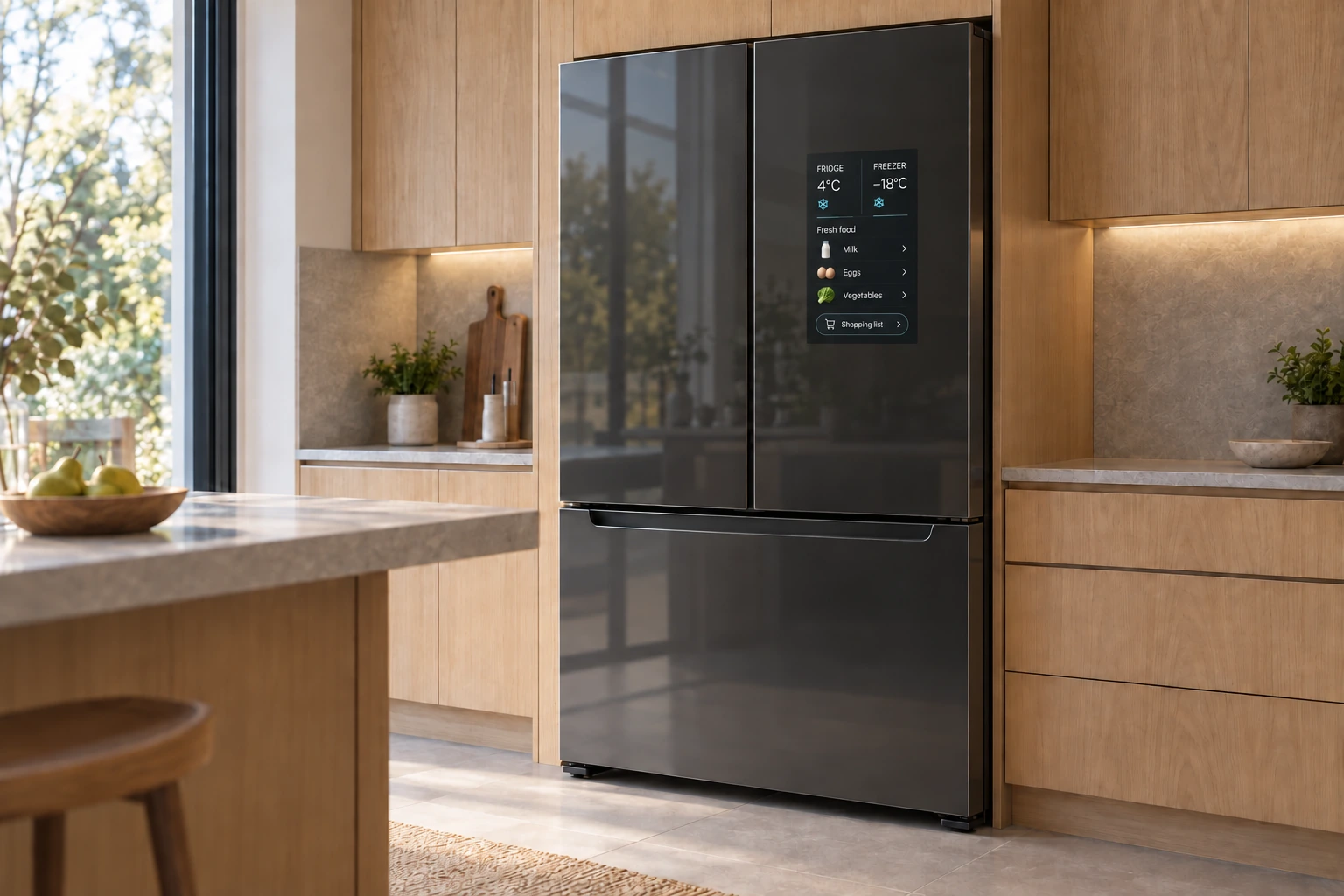
The intended refrigerator interface brings food records, compartment information and replenishment reminders together at the door. These different types of information need a clear hierarchy: temperature and appliance status should be easy to locate, while a longer food list needs room for readable entries and touch targets.
The display also has to fit within the refrigerator door. A flush exterior finish, the front cover, internal support, insulation and cable routing all influence the available integration space. Everyday use introduces changing kitchen light, different viewing heights, repeated door movement and possible moisture around the assembly.
This concept reviews the display configuration for those conditions, connecting the information layout with the mechanical and electrical requirements of a specific appliance design.
02 / Solution
Solution
The proposed configuration uses the ZC-160002-1001 as a component platform. Four design priorities guide the refrigerator-door integration review.
A portrait layout for everyday food management
The native 1200 × 1920 portrait format provides a tall canvas for grouped content. The proposed layout places compartment-temperature and status cards near the top, followed by a food list and replenishment reminders. Consistent row spacing and clearly separated actions can help organize navigation within the available screen area.
The appliance host supplies inventory records, sensor-derived compartment readings and reminder logic. The display presents this information and reports touch input. Font size, target spacing and scrolling behaviour should be evaluated at the installed screen height and normal viewing distance.
An example food-list row can pair an item name with a user-entered storage date or quantity. A separate reminder panel can group items to replenish. These are proposed software fields; the final information design should follow the appliance’s supported data and user workflow.
Readability with the intended cover glass
The drawing specifies 700 cd/m² typical luminance. The optical table lists a typical contrast ratio of 1500:1 and typical viewing angles of 85° in each direction at CR ≥ 10. These values provide selection inputs for temperature readouts, food names and status icons.
The final cover-glass specification and assembly method should be selected for the door design, then evaluated with the installed display. Reflections, cover transmission, viewing angle and kitchen lighting influence readability. Brightness settings should be reviewed with the host system for the intended day-to-day use conditions.
MIPI display and I²C touch integration
The module combines in-cell TFT construction with a 4-lane MIPI display connection and an I²C touch interface with interrupt and reset signals. The specification identifies the FT8206 driver IC, establishing a reference for host initialization and display configuration.
Engineering review should coordinate the host graphics output, touch-driver support, power sequence and cable connections. The portrait image and touch coordinates need consistent mapping. Updates to food records, temperature information and reminders remain part of the appliance software; their behaviour should be checked together with the display during prototype integration.
Mechanical planning within the refrigerator door
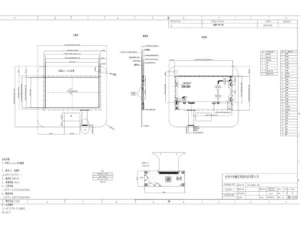
The specified module body measures 232.50 × 359.00 mm, with a nominal thickness of 5.75 mm and a 1.2 mm aluminum backplate. Door packaging should reserve space for the front cover, supports, connections and cable bends. The complete cover and mounting stack determines the finished flush appearance.
Both operating and storage ranges are specified as −30°C to +80°C. Integration review should assess actual module temperature, backlight heat, moisture isolation and condensation management within the door. The harness route should accommodate door movement and hinge clearances. Mounting retention, cable flexing and door-cycle behaviour require evaluation in the intended appliance assembly.
Technical Specifications
| Item | Specification |
|---|---|
| Module | ZC-160002-1001 |
| Display size | 16 inch |
| Native resolution | 1200 × 1920 pixels; portrait |
| Display construction | In-cell TFT; normally black; transmissive |
| Display interface | 4-lane MIPI |
| Touch interface | I²C, with interrupt and reset |
| Driver IC | FT8206 |
| Specified luminance | 700 cd/m² typical |
| Contrast ratio | 1500:1 typical; 1000:1 minimum |
| Viewing angles | 85° up/down/left/right, typical at CR ≥ 10 |
| LCD active area | 215.42 × 344.68 mm |
| Module outline | 232.50 ± 0.30 × 359.00 ± 0.30 mm |
| Body thickness | 5.75 ± 0.30 mm |
| Backplate | Aluminum; 1.2 mm thick |
| Operating temperature | −30°C to +80°C |
| Storage temperature | −30°C to +80°C |
Values follow the supplied Rev. A preliminary specification dated 2025-11-14. The optical table is marked tentative. Luminance is specified in the drawing and in the backlight table at IF = 540 mA; final output through the selected cover and assembly should be confirmed. Module body dimensions do not define the complete door assembly.
Reliability Requirements
| Test | Specified Condition |
|---|---|
| High-temperature operation | 80°C for 120 hours |
| Low-temperature operation | −30°C for 120 hours |
| High-temperature storage | 80°C for 120 hours |
| Low-temperature storage | −30°C for 120 hours |
| Humidity | 40°C / 90% RH for 120 hours |
| Thermal shock | −30°C for 0.5 hour → 25°C for 5 minutes → 80°C for 0.5 hour; 10 cycles |
These are specification requirements for verification planning, rather than completed appliance test results. The specified final inspection follows 24 hours at room temperature. Actual sample performance should be recorded during project validation.
03 / Result
Result
The concept establishes a defined display and touch configuration for a refrigerator-door food-management interface. The 16-inch portrait format, documented optical values and MIPI/I²C connections give the development team inputs for interface design, host adaptation and door packaging.
Prototype review can then confirm readability through the selected cover, touch-coordinate mapping, installation clearances and actual module temperature. Door movement, cable routing and moisture management should be evaluated with the complete assembly before the configuration is finalized.
Key Takeaway
A refrigerator-door display should be selected together with the food-information layout, appliance host and door construction. The ZC-160002-1001 provides documented display, touch and dimensional inputs for developing that interface.
Discuss Your Smart Refrigerator Display Project
Share your door drawing, available installation space, portrait interface layout, host connection and cover-glass requirements. Miqidisplay can review the display-module configuration and discuss the integration details to confirm for your refrigerator project.