




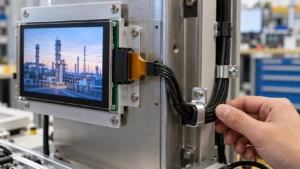



01 / Challenge
Challenge
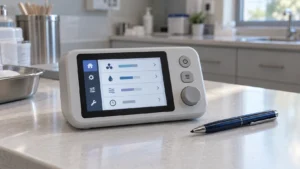
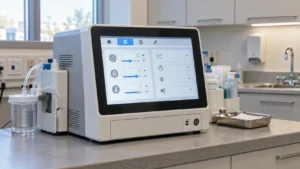
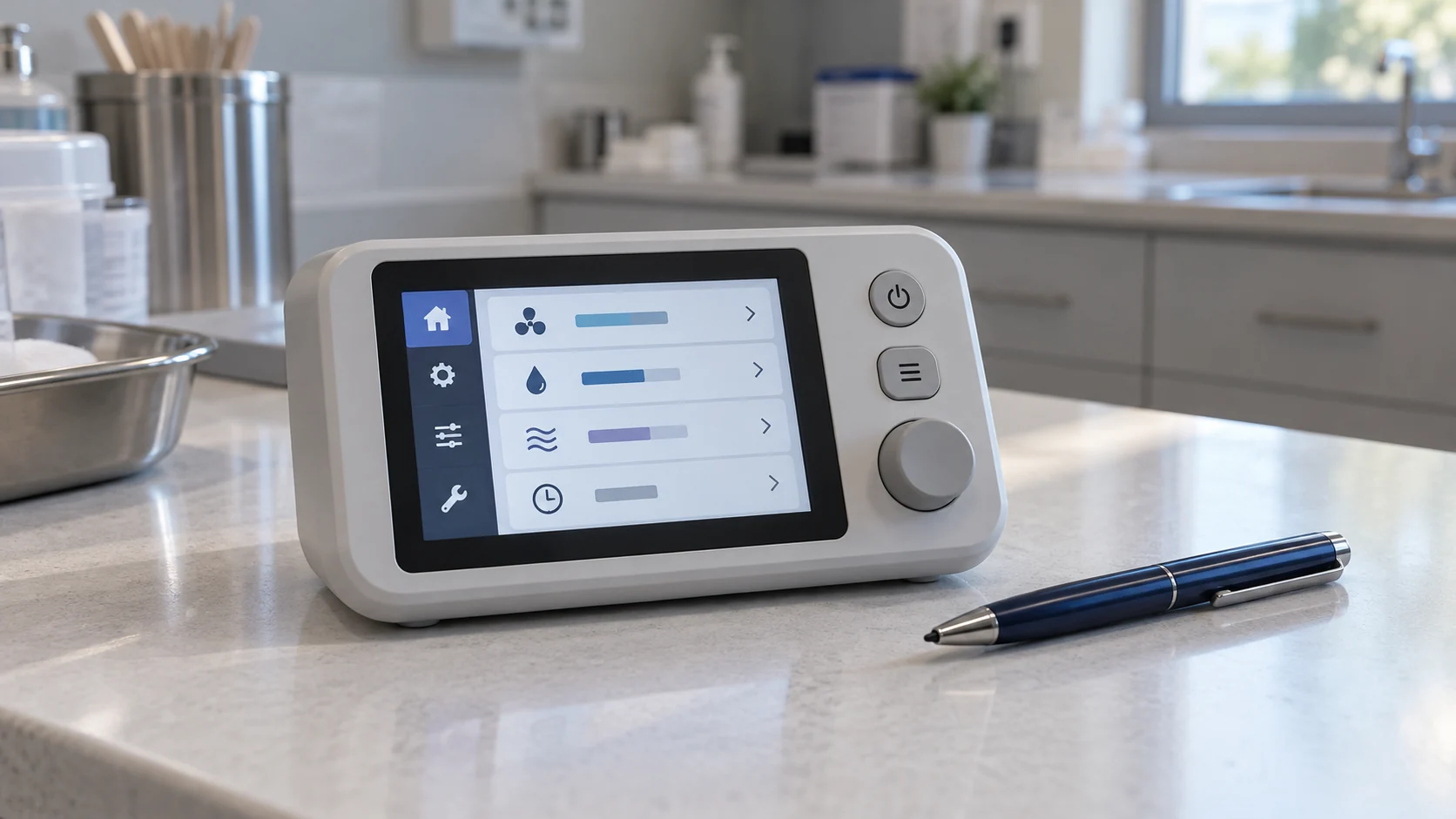
A portable medical equipment interface needs readable settings and status information within a small enclosure. This concept evaluates a 3.5-inch display and touch assembly for an indoor device control terminal, with attention to fine interface detail, contrast and host integration. No specific customer failure or completed redesign result has been supplied.
02 / Solution
Solution
The configuration is based on the 91-03521-BH1 Rev. C, with a native resolution of 1240 × 800 and a 4-lane MIPI interface. Its display specifications and G+FF touch construction provide a defined basis for a compact equipment user interface. Final device performance requires prototype evaluation.
Fine detail within a 3.5-inch format
The native layout contains 992,000 pixels, calculated from 1240 × 800. This gives the interface designer a basis for arranging icons, settings and status fields. Text size and touch-target dimensions must still be selected for the intended viewing distance; pixel count alone does not ensure legibility.
Contrast and color specification review
The optical table lists 1200:1 typical contrast, 1000:1 minimum contrast and a typical NTSC ratio of 72%, with 67% minimum. Typical viewing angles are 85° in each direction at CR ≥10. These are useful design inputs for an equipment interface. They do not establish calibrated color accuracy, DICOM performance or diagnostic image suitability.
Touch and mechanical integration
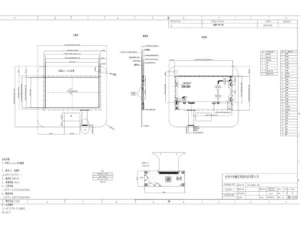
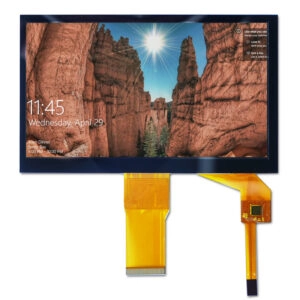
The drawing specifies a G+FF touch structure with a GT911 controller, I²C communication and 3.3 V touch supply. The nominal assembly outline is 81.85 × 60.35 × 3.75 mm. The host must be matched to the MIPI timing, FL5892C initialization, power sequence and touch coordinate mapping. The operating range is −20°C to +70°C; the storage range is −30°C to +80°C.
Technical specifications
| Item | Specification |
|---|---|
| Model | 91-03521-BH1; Rev. C; 2025-07-30 |
| Size | 3.5 inch |
| Native resolution | 1240 × 800, not 1280 × 800 |
| Pixel count | 992,000, calculated |
| Interface | 4-lane MIPI |
| Display driver | FL5892C |
| Contrast | 1200:1 typical; 1000:1 minimum |
| NTSC ratio | 72% typical; 67% minimum |
| Viewing angle | 85° U/D/L/R typical at CR ≥10 |
| Response time | 40 ms maximum |
| Touch | G+FF; GT911; I²C; 3.3 V |
| Outline | 81.85 × 60.35 × 3.75 mm nominal |
| LCD active area | 74.40 × 48.00 mm, drawing |
| Operating temperature | −20°C to +70°C |
| Storage temperature | −30°C to +80°C |
Reliability requirements
| Item | Specification |
|---|---|
| High-temperature operation | 70°C; 120 h |
| High-temperature storage | 80°C; 120 h |
| Low-temperature operation | −20°C; 120 h |
| Low-temperature storage | −30°C; 120 h |
| Humidity | 60°C; 90%RH; 120 h |
| Thermal shock | −30°C ↔ 80°C; 0.5 h each; 100 cycles |
| ESD requirements | HBM ±8 kV, 330 Ω; 150 pF. MM ±200 V, 200 pF; 0 Ω |
These are specification requirements, not completed project test records. Final inspection after testing requires 24 hours at room temperature. ESD models do not establish medical equipment EMC certification.
03 / Result
Result
The proposed configuration combines a compact 1240 × 800 interface, specified contrast and color-gamut values, and a defined touch assembly for portable medical equipment development. It gives the engineering team measurable inputs for enclosure design and prototype validation. No clinical outcome, certified medical compliance or measured improvement is claimed.
Discuss Your Compact Medical Display Requirements
Share your device drawing, host interface, viewing requirements and operating environment with Miqidisplay to review a suitable display and touch configuration.