







01 / Challenge
Challenge
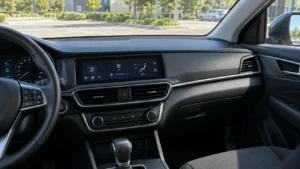
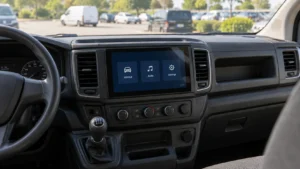
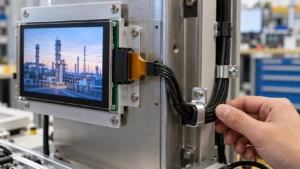
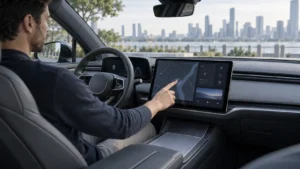
A vehicle interface needs to combine readable information, a compact dashboard footprint and a display specification suited to changing cabin temperatures. This 10.25-inch integration concept focuses on these three requirements together. Its stretched active area also calls for careful coordination of the screen layout, host graphics and mechanical opening.
02 / Solution
Solution
Brightness and contrast
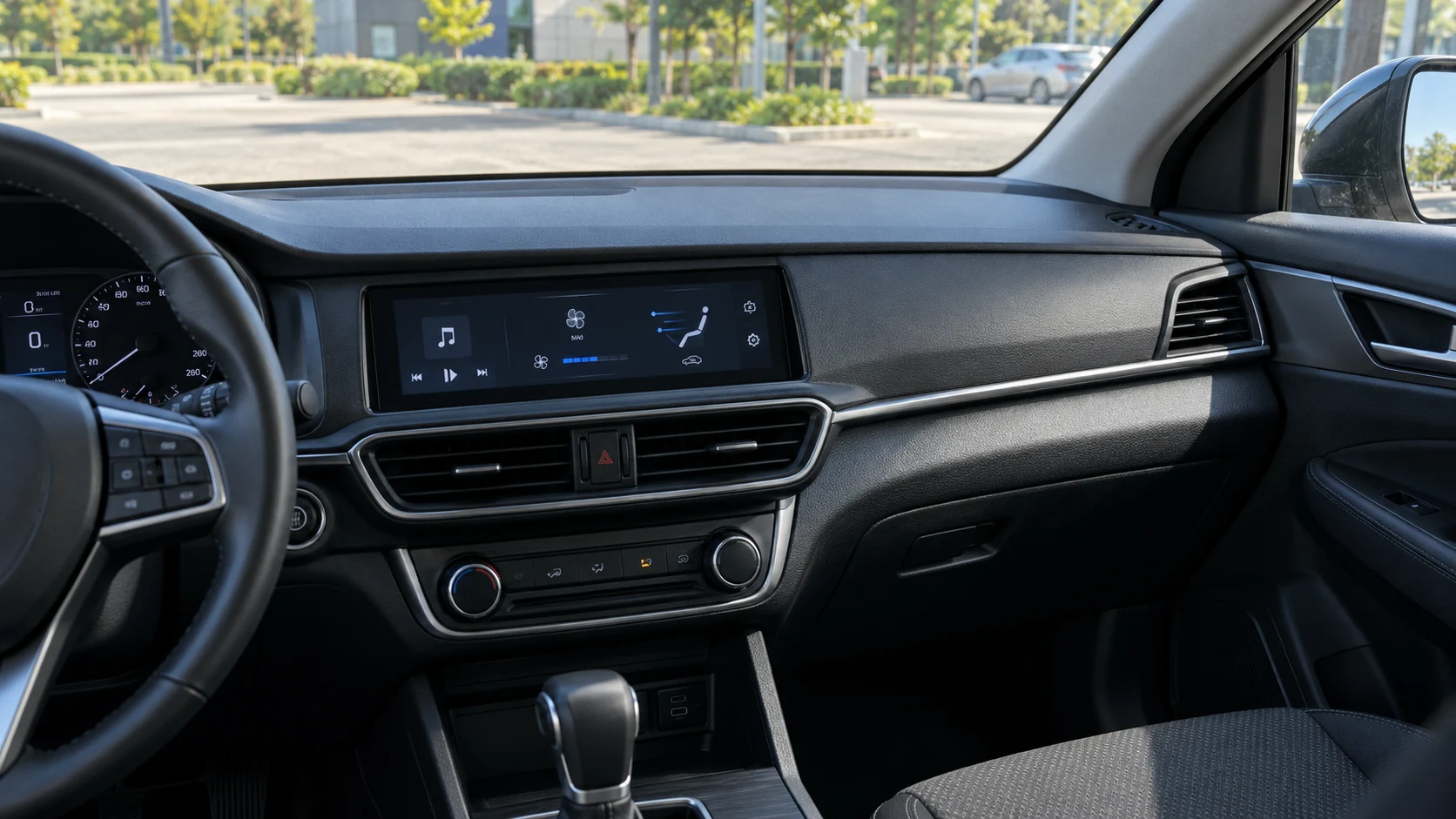
The ZC-102501-1001 provides a specification basis for a compact automotive information interface. The drawing specifies 1000 cd/m² typical luminance, while the optical table lists a typical contrast ratio of 1000:1. These values support the optical design review; final readability still depends on the cover lens, reflections, ambient light and dimming strategy.
Wide-temperature design review
The specified operating and storage ranges are both −30°C to +80°C. The reliability section defines 120-hour high- and low-temperature operating and storage tests, together with humidity and thermal-shock requirements. Module temperature, backlight power and heat paths should be reviewed in the installed assembly before system qualification.
Compact mechanical and MIPI integration
A nominal 104.5 × 256.5 × 5.05 mm module outline and a 91.37 × 243.65 mm active area define the packaging envelope. The 4-lane MIPI interface and FT8201S driver require a compatible host configuration, power sequence and initialization. Native resolution is 720 × 1920; landscape presentation must be coordinated with the host rather than assumed from the module orientation.
Technical specifications
| Item | Specification |
|---|---|
| Model | ZC-102501-1001, Rev. A, 2025-07-14 |
| Display size | 10.25 inch |
| Native resolution | 720 × 1920; landscape layout requires host rotation |
| Display interface | 4-lane MIPI |
| Driver IC | FT8201S |
| Outline | 104.50 ±0.30 × 256.50 ±0.30 × 5.05 ±0.30 mm |
| Active area | 91.37 × 243.65 mm |
| Typical luminance | 1000 cd/m²; drawing specification |
| Contrast | 1000:1 typical; 800:1 minimum |
| Viewing angle | 85° each direction, typical, CR ≥10 |
| Response time | 30 ms typical; 35 ms maximum |
| NTSC ratio | 65% typical |
| Operating temperature | −30°C to +80°C |
| Storage temperature | −30°C to +80°C |
Reliability requirements
| Test | Specified condition |
|---|---|
| High-temperature operation and storage | 80°C, 120 hours each |
| Low-temperature operation and storage | −30°C, 120 hours each |
| Humidity | 40°C, 90%RH, 120 hours |
| Thermal shock | −30°C → 25°C → 80°C; 0.5 hour → 5 minutes → 0.5 hour; 10 cycles |
These are specification requirements, not completed project test records. Optical values apply under the specified measurement conditions and do not establish identical performance across the entire temperature range.
03 / Result
Result
The proposed configuration brings brightness, temperature limits and a stretched form factor into one defined integration brief. It gives the engineering team measurable inputs for dashboard packaging, host adaptation and prototype evaluation. Final installed performance should be established through application-specific testing.
Discuss Your Automotive Display Requirements
Share your target installation space, host interface, brightness needs and operating environment with Miqidisplay to review a suitable display configuration.


