








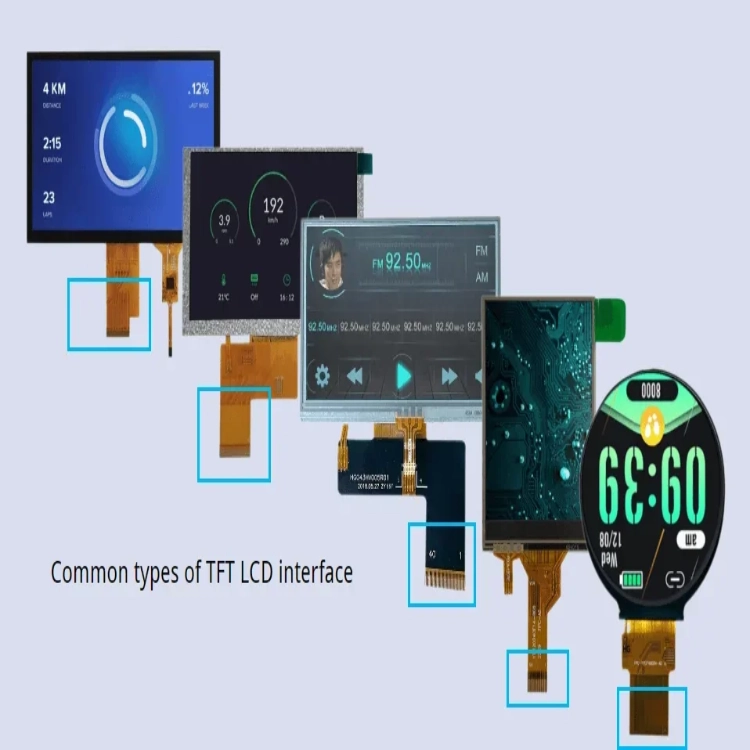
Display interfaces often receive less attention than screen resolution or brightness. Yet they play a critical role in system design. These interfaces determine how a display communicates with the host processor. They also decide how efficiently data transfers occur. In addition, they affect how seamlessly the module integrates into the overall hardware architecture. Selecting an inappropriate interface can introduce bottlenecks. It can increase development time or raise costs. On the other hand, the optimal choice enhances performance and simplifies integration.
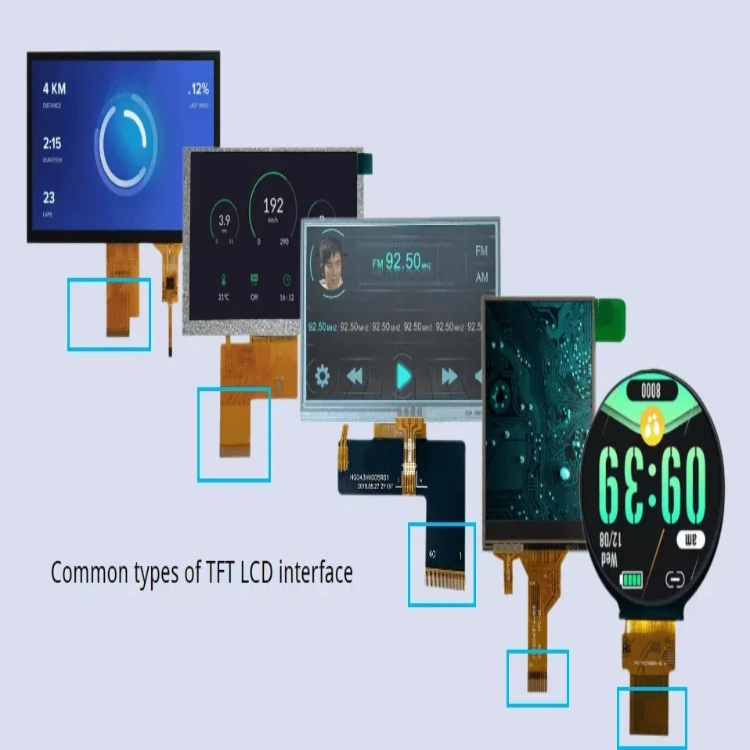
Engineers involved in embedded systems, industrial controls, medical equipment, and consumer devices benefit from a thorough understanding of available options. Knowledge of interface strengths and limitations streamlines selection. It also supports informed hardware decisions.
What is a Display Interface?
A display interface serves as the communication pathway. It transfers image data, color information, and control signals from a controller or processor to the display module. It establishes the format, timing, and electrical requirements for moving pixel information to the screen.
In TFT displays, the interface directly influences data transfer speed. It affects accuracy of image rendering, pin count requirements, driver complexity, and board space utilization. Different interfaces balance trade-offs between bandwidth, power consumption, and ease of implementation. This makes the choice foundational to overall system architecture.
How Interfaces Impact Performance, Integration & Cost
The selected interface significantly affects overall system performance. It also influences hardware compatibility and project economics. High-speed serial interfaces support elevated resolutions and refresh rates. These suit dynamic content. But they often demand more sophisticated signal routing and compatible processors. In contrast, simpler parallel or serial options reduce design complexity. They suit cost-sensitive or low-power applications.
Processor compatibility represents another key factor. Many embedded controllers include native support for specific interfaces. This limits options if mismatched. Integration effort varies widely. Some interfaces require minimal additional components. Others need dedicated decoder chips or careful impedance matching. Cable length, electromagnetic interference resistance, and power draw also factor into total cost of ownership.
Common Types of TFT Interface
TFT displays accommodate diverse interface types. These address varied application requirements. Some emphasize high bandwidth for video. Others prioritize minimal pin usage or straightforward implementation. The primary options include Parallel MCU, HDMI, MIPI DSI, SPI, RGB, and LVDS.
Each type features distinct electrical characteristics, timing protocols, and hardware demands. These shape connection methods and operational capabilities.
Parallel MCU Interface
How It Works
The parallel MCU interface transmits data across an 8-bit or 16-bit bus. It uses control lines such as Read/Write, Chip Select, and Register Select. Data bits transfer simultaneously. This simplifies timing requirements while increasing the total number of connections. This direct bus-style approach aligns well with numerous microcontroller architectures.
Advantages of Parallel Interfaces
- Straightforward integration with embedded microcontrollers
- Elimination of complex high-speed differential routing
- Strong compatibility with low- to medium-resolution applications
When to Choose Parallel
Parallel MCU interfaces perform effectively in systems with infrequent display updates. These include industrial control panels, instrumentation interfaces, and portable devices. Here simplicity outweighs maximum speed.
HDMI Interface
How It Works
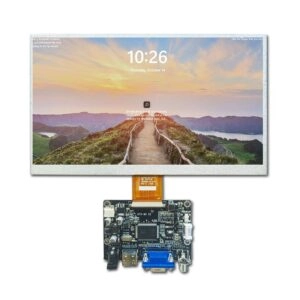
HDMI transmits uncompressed video, audio, and auxiliary data over a single standardized cable. It uses transition-minimized differential signaling. The interface incorporates a defined connector format. This supports plug-and-play connectivity across compatible devices.
Advantages of HDMI Interface
- Delivery of high-resolution video alongside audio channels
- Utilization of widely available cables and connectors
- Simplified system-level integration without custom wiring
When to Choose HDMI
HDMI suits applications requiring rich multimedia output. It also works for direct compatibility with single-board computers, media processors, or external video sources. It excels in scenarios demanding straightforward connectivity to standard consumer or industrial platforms.
MIPI DSI Interface
How It Works
MIPI DSI operates as a high-speed serial protocol. It is designed for mobile and compact devices. It employs differential signaling across one or more data lanes plus a clock lane. This enables efficient pixel data transfer with reduced pin counts compared to parallel methods.
Advantages of MIPI DSI Interfaces
- Support for high resolutions and rapid refresh rates
- Minimized pin requirements and simplified PCB routing
- Potential power efficiency gains in data-intensive compact designs
When to Choose MIPI DSI
MIPI DSI proves advantageous in space-constrained products. These need detailed graphics, fluid motion rendering, and optimized energy use. Typical deployments include portable electronics, advanced wearables, and sophisticated embedded human-machine interfaces.
SPI Interfaces
How It Works
SPI functions as a synchronous serial protocol. It shifts data one bit at a time. It uses dedicated clock, data, and chip select lines. Often it includes an additional data/command control signal. The master-slave configuration keeps hardware requirements minimal.
Advantages of SPI Interfaces
- Significantly reduced pin count
- Straightforward connection topology
- Suitability for power- and space-constrained environments
When to Choose SPI
SPI interfaces fit applications displaying primarily static or slowly updating content. These include metering devices, compact control units, and handheld instruments. Here bandwidth demands remain modest.
RGB Interfaces
How It Works
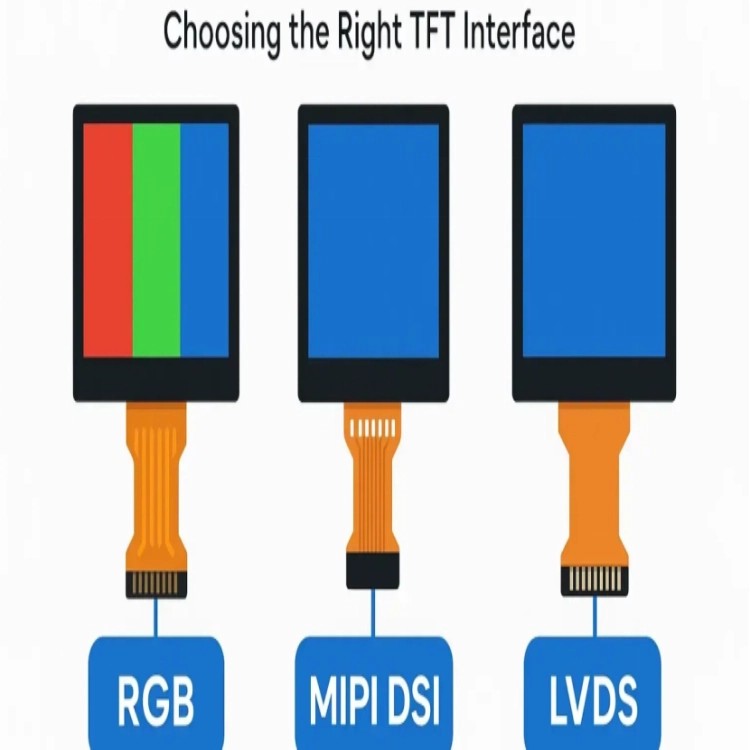
RGB interfaces deliver pixel information in parallel red, green, and blue components. These are synchronized by a pixel clock and horizontal/vertical sync signals. Each clock cycle transfers complete color data for one or more pixels. This enables direct and timely screen updates.
Advantages of RGB Interfaces
- Rapid transmission of full-color information
- Support for real-time image refreshing
- Broad compatibility with graphic controller chips
When to Choose RGB
RGB interfaces serve projects requiring responsive visuals and continuous updates. These include industrial operator panels, interactive kiosks, and media playback devices.
LVDS Interfaces
How It Works
LVDS utilizes paired differential signal lines. These carry opposite voltage swings to transmit data with high noise immunity. This approach maintains signal integrity over extended distances and at elevated frequencies.
Advantages of LVDS Interfaces
- Robust performance at high data rates
- Capability for longer cable or trace lengths
- Reduced susceptibility to electromagnetic interference
When to Choose LVDS
LVDS interfaces address demanding environments in industrial machinery, medical imaging systems, and automotive displays. Here reliable high-speed video transmission remains essential. This holds despite potential cable runs or noisy conditions.
Choosing the Right Interface for Your Project
Interface selection requires careful evaluation of project priorities. These include required resolution, refresh rate, power budget, physical constraints, and host processor capabilities. High-resolution or video-intensive applications often align with MIPI DSI, HDMI, or LVDS. These offer bandwidth advantages. Lower-resolution or battery-powered designs frequently favor SPI or parallel MCU interfaces. They minimize complexity and cost.
Board layout considerations also influence decisions. Differential interfaces may need controlled impedance routing. Parallel buses demand more GPIO pins. Cable or connector requirements further affect mechanical design. Balancing these factors prevents integration challenges. It supports efficient development cycles.
Interface Integration Support from Display Manufacturers
Successful deployment extends beyond interface specification. It encompasses reliable implementation support. Experienced display manufacturers provide comprehensive documentation. They offer reference schematics, timing diagrams, and sample driver code. These accelerate integration. Engineering teams often assist with compatibility verification and troubleshooting during prototype phases.
Many manufacturers further accommodate project-specific needs. They do this through customizable interface configurations, integrated touch solutions, or value-added features such as onboard controllers. For complex requirements, direct collaboration with technical specialists helps align display capabilities with system architecture. This occurs from initial concept through volume production.
As a leading display manufacturer and supplier with over 20 years of OEM/ODM expertise, Miqidisplay delivers a comprehensive portfolio of TFT LCD displays, industrial monitors, x86 panel PCs, color OLED modules, and related solutions. The company specializes in high-quality standard and custom TFT products. These feature multiple interface options, IPS panels, high-brightness variants, and touch integration. They suit industrial, medical, automotive, and embedded applications. With certifications including ISO-9001, TS-16949, and ISO-14001, Miqidisplay emphasizes reliable supply chains, precision engineering, and one-stop services. These help manufacturers reduce development timelines and achieve consistent performance across production volumes.
Conclusion
Business seeking dependable TFT display solutions benefit from partnering with an established display manufacturer. This manufacturer must be capable of supporting both standard and fully customized requirements. Miqidisplay offers extensive interface options across its TFT LCD display lineup, industrial monitors, and panel PCs. These come backed by expert engineering guidance and rapid response times.
OEMs and ODM partners can leverage Miqidisplay’s custom solutions capabilities. They modify interfaces, adjust brightness levels, incorporate specific touch technologies, or adapt mechanical designs for unique environmental demands. Whether developing next-generation industrial equipment or scaling production of embedded devices, collaboration with this display manufacturer streamlines sourcing. It ensures long-term product reliability.
Contact the Miqidisplay team today to discuss project specifications. Request technical documentation or obtain a same-day quote for standard or custom TFT display modules. Experienced engineers stand ready to provide integration recommendations tailored to specific processor platforms and performance targets.
FAQ
What is the most suitable TFT interface for high-resolution industrial applications?
High-resolution industrial systems often perform best with MIPI DSI or LVDS interfaces. These offer support for elevated data rates and strong signal integrity over distance.
How does pin count differ across common TFT interfaces?
Parallel MCU interfaces typically require the highest pin counts. SPI and MIPI DSI utilize significantly fewer pins. This makes them preferable for compact designs.
Can display interfaces be customized for specific processor compatibility?
Many display manufacturers accommodate custom interface adaptations. These include modifications to timing, voltage levels, or integration of bridge chips to match unique host requirements.
What factors should influence interface selection beyond speed?
Power consumption, electromagnetic compatibility, available board space, cable length needs, and long-term supply stability all warrant consideration during selection.
Are HDMI interfaces appropriate for embedded industrial projects?
HDMI interfaces work effectively in embedded projects. These require straightforward multimedia connectivity or compatibility with standard single-board computers and video sources.