

Display technologies serve as the base for today’s electronic devices. These range from smartphones and tablets to industrial monitors, medical gear, and car interfaces. The market provides many kinds of display screens. They fall mainly into two groups: back-lit types (mostly LCD-based) and self-emissive types (OLED-based). Each group splits into several subtypes. Every subtype has its own features that fit certain uses. This article looks at the usual types one by one. It draws on their history and basic working ideas.
LCD
LCD means Liquid Crystal Display. This technology has led the display field for many years. It owes this to its flexibility, low price, and wide use. LCD screens show up in lots of devices. Examples include mobile phones, computers, watches, industrial controls, and medical tools.
The main idea places liquid crystal material between two flat glass plates. Voltage applied changes how the liquid crystal molecules line up. This controls light coming from a backlight source. The changes produce shades, patterns, and pictures. An RGB color filter layer added allows full color.
LCD displays need a backlight, usually LED type. This affects thickness, power use, and how well they work in different settings.
TN
TN, or Twisted Nematic, stands as one of the first and most usual LCD panel kinds. In TN displays, liquid crystal molecules twist 90 degrees when voltage shifts at the panel edges. This setup works as a simple light valve together with polarizers.
TN panels commonly rely on static or passive drive methods for basic tasks. These include showing characters or simple images. They often come in black-and-white styles like pen-type, character-type, or dot-matrix screens. Some versions use active matrix driving through TFT (thin-film transistors). This creates TN-TFT setups, often called standard TFT LCDs.
In structure, TN screens have several layers. These include an ultra-thin twisted liquid crystal mix between glass plates with clear electrodes, alignment layers, color filters (for color ones), and outside polarizers. Benefits cover low cost, high output, and quick response times. Drawbacks include narrow viewing angles and limited display detail.
STN
STN, or Super-Twisted Nematic, grew from TN technology. It aimed to fix TN limits, especially for matrix displays that handle complex graphics. STN panels twist liquid crystals by 180 to 270 degrees. This greatly widens viewing angles. It also allows more driving channels for higher resolution or capacity.
Compared with TN’s 90-degree twist, STN boosts contrast and grayscale levels. It keeps good points like quick response, high light passage, low cost, and easy production.
There are many types of STN liquid crystals:
FSTN- Film Compensated STN
CSTN- Color Super-Twist Nematic
DSTN- Dual-scan Super Twisted Nematic
DSTN- Double layer Super Twisted Nematic
TFT
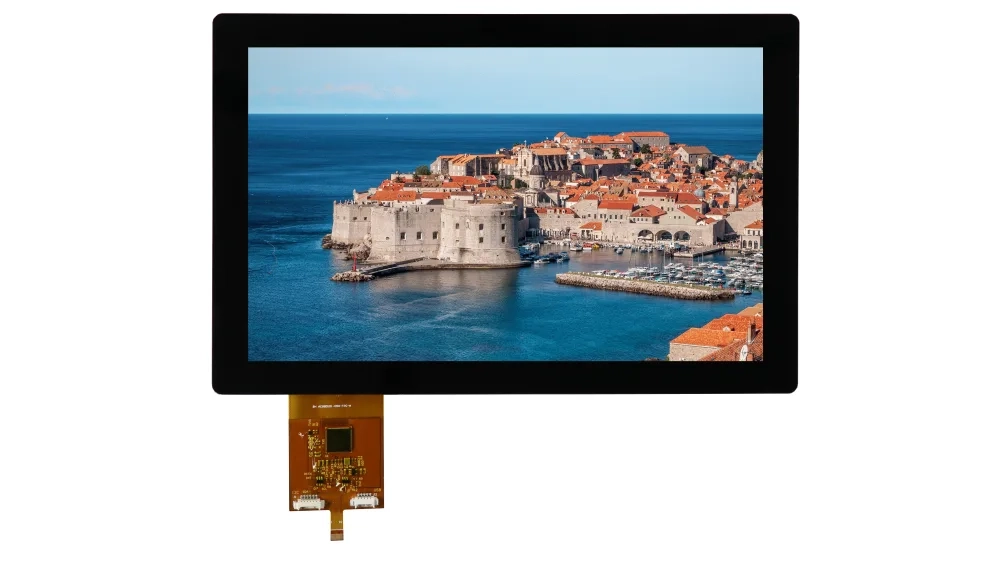
TFT, or Thin Film Transistor, places a transistor behind each liquid crystal pixel for active matrix control. This arrangement allows fast addressing. It brings better brightness, contrast, depth, and lively colors.
TFT forms part of the active matrix LCD group. It beats passive matrix kinds in refresh speed and picture quality. It handles detailed graphics and video play quite well.
Main strengths lie in great visual results. Weak points include higher power draw and raised production costs compared to simpler LCD types.
IPS
IPS, or In-Plane Switching, grows straight from TFT technology. People often call it “Super TFT.” It came about to fix issues in older LCDs. IPS puts electrodes on the same flat level. This lets liquid crystal molecules rotate sideways (horizontally) instead of twisting up and down.
The setup gives quicker and steadier response times, particularly with moving content. It cuts down on image smear, shake, and ghosting in action. IPS offers wider viewing angles, better color truth, and steady contrast even from side views.
IPS shines in professional and top-level uses that need exact pictures.
OLED
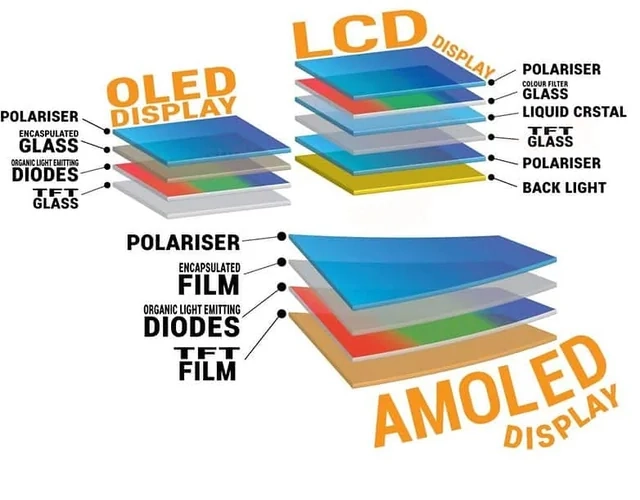
OLED, or Organic Light-Emitting Diode, stands apart from LCD. It removes any need for a backlight. Thin layers of organic material sit on glass or bendable base. They give off light right away when electric current goes through.
OLED benefits feature ultra-thin builds (often under 1mm versus 3mm for LCD), lighter feel, wide viewing angles with no warp, response times one-thousandth of LCD, work in low temperatures (down to -40°C), high efficiency, low power draw, eco-friendly nature, and bendable options for curved shapes.
These traits make OLED perfect for high-end, small, or fresh designs.
PMOLED
PMOLED, or Passive Matrix OLED, uses crossing cathode and anode strips with organic layers between them. The crossing points create pixels. These pixels light up when current passes selected strips. Brightness changes with the current applied.
PMOLED making stays fairly simple. It works well for small screens (2-3 inches) that show text, icons, or basic graphics. Examples include mobile phones, PDAs, or MP3 players. Outside circuits run the matrix. This causes higher power use than active kinds. Still, it often stays lower than similar LCDs in many situations.
Efficiency stands highest with still or low-detail content.
AMOLED
AMOLED, or Active Matrix OLED, includes a complete cathode layer, organic materials, and an anode grid supported by TFT circuits. The TFT grid manages pixel light-up exactly.
This active method lowers power needs versus PMOLED. It relies less on outside circuits. It allows higher refresh rates for smooth video. It also grows to bigger sizes.
AMOLED fits monitors, televisions, digital signs, and strong video uses.
Micro OLED
Micro OLED uses single-crystal silicon back-planes for self-lighting. It brings outstanding pixel density (high PPI), slim build, light weight, wide viewing angles, fast response, and good efficiency.
These features suit near-eye uses. Examples include VR/AR headsets or small high-resolution gear.
Knowing these display kinds helps pick the right technology for different needs. Choices go from low-cost simple interfaces to advanced, strong visuals.
FAQ
What is the main difference between LCD and OLED displays?
LCD depends on a backlight and liquid crystals to adjust light. OLED uses self-emissive organic materials. This allows thinner builds, real blacks, and quicker responses.
Which display type offers the best viewing angles?
IPS (within LCD) and OLED variants (PMOLED, AMOLED, Micro OLED) give excellent wide-angle results. They show very little color change or warp.
Are TN displays still relevant today?
TN stays cheap for basic uses that need quick response times. Yet it falls behind in viewing angles and color next to IPS or OLED.
What makes AMOLED suitable for large screens?
AMOLED’s active matrix TFT control cuts power use. It supports high refresh rates. This makes it great for monitors, TVs, and signs.
How do STN displays improve on TN technology?
STN raises the twist angle to 180-270 degrees. It boosts viewing angles, contrast, and driving power for more complex graphics.
Partner with a Trusted Manufacturer for Custom Display Solutions
As a leading manufacturer, supplier, and factory of high-quality LCD, TFT, IPS, OLED, and specialized display technologies, Miqidisplay delivers OEM/ODM services tailored to B2B needs. With over 20 years of expertise, ISO-9001, ISO-14001, and TS-16949 certifications, and a focus on custom R&D, Miqidisplay offers TFT LCD displays, OLED panels (including flexible and color variants), special technologies like transparent screens and e-Paper, industrial LCD monitors, and stretched bar displays. The company provides one-stop solutions, including touchscreen integration, interface customization, backlight modifications, and strict multi-stage quality control for industries such as medical, automotive, industrial control, and security systems.
Partners benefit from rapid prototyping, 90% same-day shipping, competitive pricing from stable sourcing of panels (e.g., AUO, Innolux, BOE), and 24/7 global support. Contact the Miqidisplay team today via email at mary@miqidisplay.com, WhatsApp at +86 188 7965 2960, or the 24/7 live chat on the website to discuss project requirements, request tailored quotes, or initiate custom solution development. Elevate production with reliable, innovative display technologies designed for long-term performance and efficiency.