




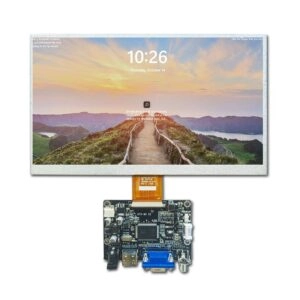
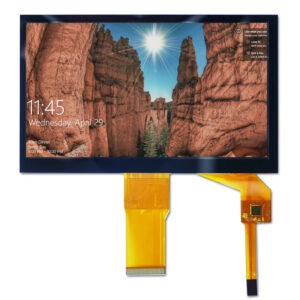
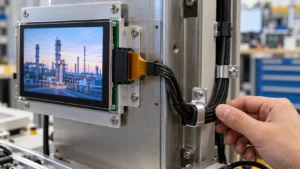



For applications displayed under strong outdoor light, we recommend to use IPS panels with brightness above 800 nits and 178° viewing angle. For low-speed display applications like display texts SPI interfaces would be sufficient, for high-definition video streams like HD video however MIPI interfaces are needed to ensure fluent display.
Interface
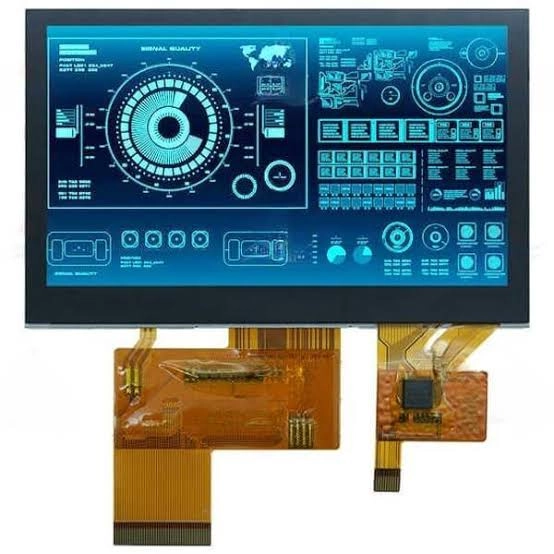
Choosing the right interface for your TFT LCD is critical for ensuring that your system is fully compatible, functions correctly and maintains reliability over time. Industrial, medical and embedded applications demand different trade-offs between bandwidth, pin count, power and distance.
Bandwidth and Data Rate
Resolution alone does not determine interface requirements. Engineers must account for blanking intervals that add overhead to the pixel clock.
The pixel clock formula is:
Pixel Clock = (H_Active + H_Blanking) × (V_Active + V_Blanking) × Refresh Rate
For a common 800×480 resolution at 60 Hz:
Horizontal active pixels: 800
Horizontal blanking: typically ~256
Vertical active pixels: 480
Vertical blanking: typically ~45
Note that 32×16=512, so the actual pixel frequency for 512×384 is about 33.2 MHz, not 23 MHz as given in the “naive” case. For higher resolution displays such as 1920×1080, the required pixel frequency is approximately 148.5 MHz. The interface must be able to support such high rates without dropping frames.
SPI and MCU Interfaces
For SPI and MCU (parallel) interfaces, the interfaces to the LCD module typically include internal GRAM (graphics RAM) since the bandwidth of these interfaces is not sufficient to transfer full frames in real time at high refresh rates. Data is written to the GRAM by the host and then scanned out by the driver IC.
Why SPI suits static or low-speed content: Standard SPI operates serially with limited clock speeds, typically under 50 MHz. Transmitting a 16-bit RGB565 pixel requires 16 clock cycles, yielding low pixel fill rates unsuitable for smooth video on larger panels. QSPI (Quad-SPI) improves this by using four data lines, boosting throughput, but still limits dynamic content.
MCU 8080 Parallel Bus Considerations
Using the parallel bus is more efficient than SPI in parallel mode. When operating in 16-bit mode one write command transfers one RGB565 pixel. As with other interface modes the performance is determined by the write cycle timing (Twc) and the WR pin. The current driver ICs are able to operate at higher cycles than before. However for efficiency reasons most designs are using the DMA for writing. Tearing Effect (TE) signals can be used to synchronize the writing of the pixels in order to prevent unwanted visual effects.
These interfaces are generally used for smaller panels up to 4-5 inches in size. They are also suitable for static UIs (User Interfaces) for industrial controls and instrumentation.
RGB TTL Interface
The RGB (TTL) interfaces are “dumb panels” which do not have any onboard GRAM. The host must keep streaming pixel data from the host’s main memory via a framebuffer. This requires a significant amount of memory and a capable LCD controller which supports DMA.
The parallel approach makes use of many signal lines (up to 28+ for RGB888) and may cause problems with EMI, crosstalk and skew on higher resolutions and frame rates. For mid-range applications this approach is suitable, but for higher resolutions the wiring of the signal lines and the signal integrity on the PCB tend to become a problem for larger displays.
LVDS Interface
LVDS (Low Voltage Differential Signaling) enables the use of RGB signals, serializing them into a differential signal. LVDS uses fewer wires, increasing the signal speed and length, and is very common in industrial monitors and larger screens.
LVDS single channel designs can handle high pixel rates whilst LVDS dual channel designs can support Full HD resolutions. Low voltage swing (~350mV) ensures low power and low EMI.
MIPI DSI Interface
The high-resolution consumer and portable markets are especially well serviced by the MIPI DSI specification, making use of the D-PHY for multi-lane high-bandwidth operation (hundreds of Mbps to Gbps per lane). While the packet based protocol incurs a certain amount of overhead, this has to be taken into account in the bandwidth planning, DSI allows for efficient high-resolution operation at FHD and beyond with few pins.
MIPI is the interface of choice in modern TFT LCD modules used in smart phones, tablets and other compact industrial applications, as it offers an optimal mix of performance and integration.
Brightness
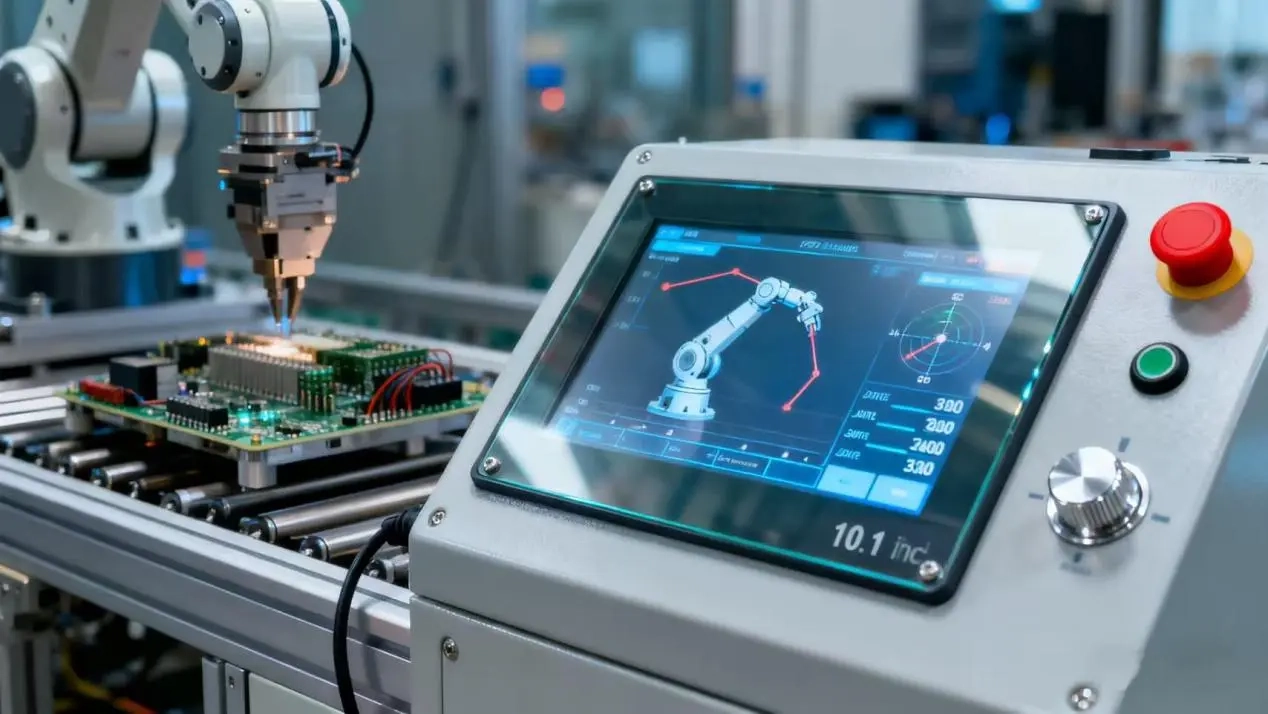
A device’s brightness is measured in nits (cd/m²) and allows the user to be seen in different ambient light environments. For indoor usage 250-500 nits is usually sufficient. For use in outdoor environments or in high-glare environments 700-1000+ nits is required to ensure readability in the sun.
Increasing the brightness of a backlight, either by adding more LEDs to the backlight or by using special optical films, increases the power consumption and can generate heat. Manufacturers strive to make the most efficient product and to manage the heat generated. IPS panels can maintain color accuracy even at higher brightness levels and still offer a wide viewing angle.
High brightness industrial and medical displays can provide good visibility in very bright ambient light environments such as an operating room under bright surgical lights or a factory floor with bright production lights. Our custom displays can also have the backlight design modified for specific voltage, color, or NVIS compatibility.
Viewing Angle
Viewing angle is a measure of how wide you can view a screen while maintaining adequate contrast and color. While standard TN panels have limited viewing angles, IPS panels can offer up to 178° of viewing angle with consistent image quality.
When many people are using a device, or it is mounted at an angle in a vehicle or industrial setting, HMIs require viewing angles that are quite wide. These angles are far better for IPS panels than for many other display technologies. IPS panels deliver same color and contrast at all viewing angles.
The effective viewing angle is influenced by the use of a polarizer, by compensation films and by anti-glare coatings. For demanding applications displays with a wide viewing angle are selected and are tested in the intended application environment.
Additional Selection Factors
Beyond interface, brightness, and viewing angle, consider operating temperature range (e.g., -30°C to 85°C for industrial use), touch integration (capacitive or resistive), durability features like IP ratings, and certifications. Round TFT LCDs or bar-type formats may suit specific form factors.
Customization options for cable length, connector type, cover glass, mounting and PCB modifications to allow design to fit end product requirements.
Applications Across Industries
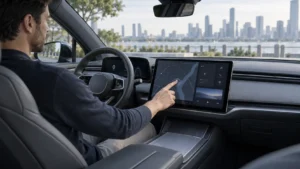
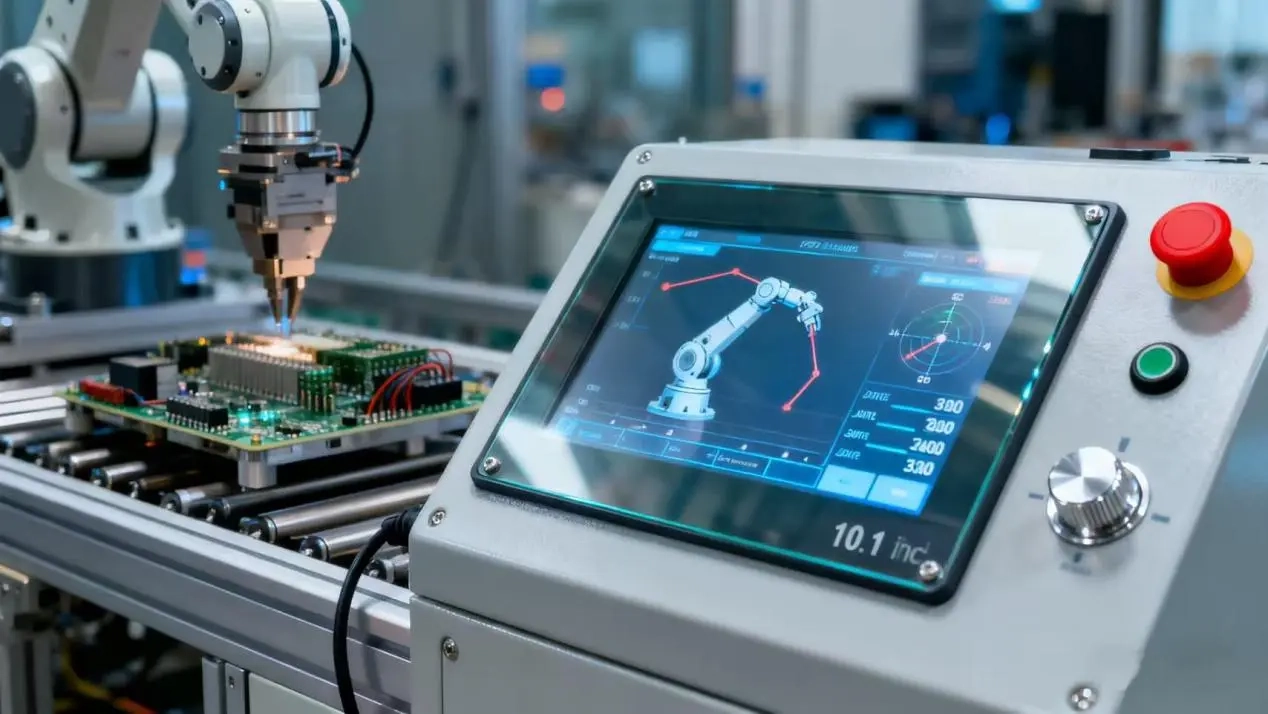
TFT LCD modules with appropriate characteristics are used in a variety of fields. Industrial monitors are hardy and can operate in a wide range of temperatures, and are equipped with appropriate interfaces to be used in HMI systems. In the medical field, TFT LCD modules are used as high brightness displays that are equipped with antibacterial surfaces and have high image quality. Automotive and outdoor use TFT LCD modules have high nits and wide viewing angles.
Conclusion
TFT LCDs can be selected based on a number of characteristics and their requirements for a specific application. A TFT can be best selected by taking into account the maximum interface bandwidth, required brightness for the ambient lighting, and the viewing angles. The TFT can then be selected to meet the requirements for a specific user interaction and system reliability.
Miqidisplay, a leading display manufacturer, provides high-end custom TFT LCD displays, industrial displays, and 1-stop shopping service to manufacturers and suppliers. Specially designed to serve the industries such as industrial, medical, etc., Miqidisplay’s expertise in display customization and reliable supply supports businesses sourcing for top quality display parts and total display solutions.
FAQ
What interface is best for high-resolution video on TFT LCDs?
For high-resolution video at high frame rate on TFT-LCDs, MIPI DSI is the interface of choice since it supports multiple lanes to increase bandwidth.
What level of brightness is required for using outdoor TFT displays?
Our experience shows that more than 800 cd/m² in combination with IPS panel technology and appropriate anti-reflective coating is necessary for good readability in the sun.
What are wide viewing angles used for?
Wide viewing angles are very important because images retain their high quality right up to a viewing angle of 178°. Thus in multiuser installations and also in installations where the screen is set at an angle, images are always presented consistently and without loss of quality to all viewers.
Can TFT LCD modules be customized?
Yes. TFT LCD modules can be tailored to fit interfaces or levels of brightness of customers’ choice. TFT LCD manufacturers offer an extensive variety of options when it comes to customization. Some of them include interfaces, level of backlight intensity as well as various forms and shapes of TFT modules.
Conclusion
Manufacturers and suppliers seeking reliable TFT LCD displays, industrial monitors, round LCDs, or fully customized solutions should partner with an experienced display manufacturer. Miqidisplay offers a comprehensive portfolio of standard and custom TFT LCD products, expert engineering support, and efficient supply chain services. Contact the team today to discuss project requirements, request quotes, or explore custom solutions for industrial, medical, or specialized applications. Leverage proven expertise to enhance product offerings and meet demanding market needs.